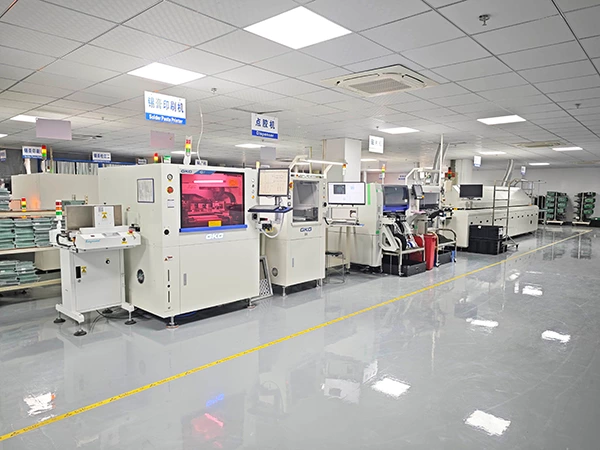
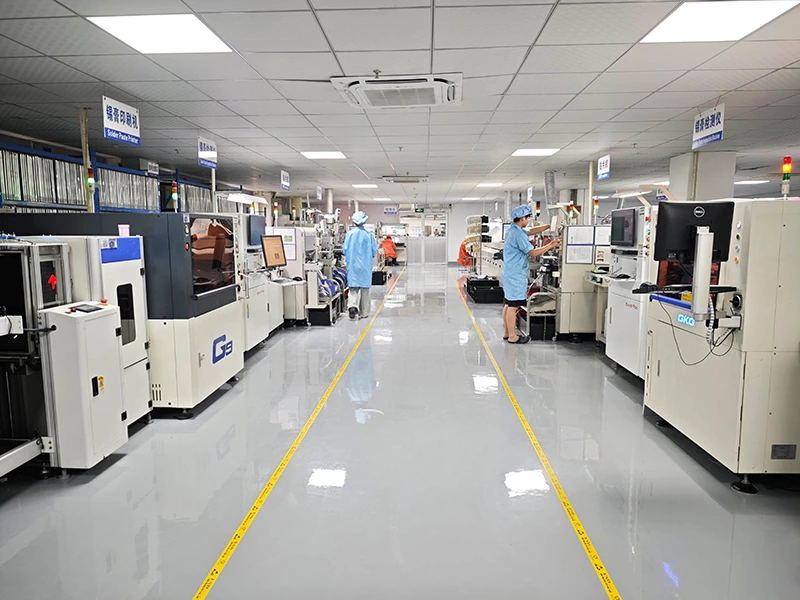
PCBA Factory Floor Marking Colors Explained: Yellow Lines, Red Lines, White Frames and Zebra Tape
Floor markings are an important part of visual management in a PCB assembly (PCBA) factory. They help define traffic routes, identify restricted areas, indicate equipment positions, and make potential hazards easier to recognize.
In an electronics manufacturing facility, different colors and marking patterns may be used for different purposes. Yellow solid lines commonly identify traffic aisles and designated equipment positions. White markings can define workstation tool and fixture locations. Red markings may identify restricted areas, such as defective-product storage or hazardous chemical storage. Yellow-and-black zebra tape is commonly used to highlight physical hazards, while red-and-white markings can help keep fire equipment and emergency access areas clear.
However, floor marking systems are not identical across all factories. Their meanings should always be defined by the facility's documented visual management standard and applicable local safety requirements.
This guide explains common PCBA factory floor marking colors, their practical applications, and what buyers should check during a manufacturing facility audit.
Why Are Floor Markings Important in a PCBA Factory?
A PCBA factory contains multiple production processes, material storage areas, testing stations, and equipment operating at the same time. Materials and personnel move between the warehouse, SMT production lines, through-hole assembly areas, testing stations, and finished goods storage.
Without clearly defined floor markings, several problems may occur:
- Materials and carts may obstruct production aisles.
- Equipment may be placed outside its designated position.
- Defective products may be mixed with qualified products.
- Hazardous materials may be stored in inappropriate areas.
- Fire equipment and emergency exits may become difficult to access.
- Personnel may enter areas with physical or operational hazards.
Floor markings help establish visible boundaries and make workplace rules easier to follow. They also support daily housekeeping, production organization, and internal factory audits.
In a PCBA manufacturing environment, floor marking is not simply a matter of appearance. It is part of a broader visual management system that connects workplace organization with safety and production control.
PCBA Factory Floor Marking Color Guide
The following table explains common floor marking applications found in industrial and electronics manufacturing environments. The exact color assignments may differ according to a factory's internal standard.
| Floor Marking | Common Application | Main Purpose |
| Yellow solid lines | Main traffic aisles and designated equipment positions | Define movement routes and equipment locations |
| White markings | Workstation tools, fixtures, and jigs | Identify designated storage and positioning areas |
| Red solid lines | Defective-product areas or designated hazardous chemical areas | Identify restricted or controlled spaces |
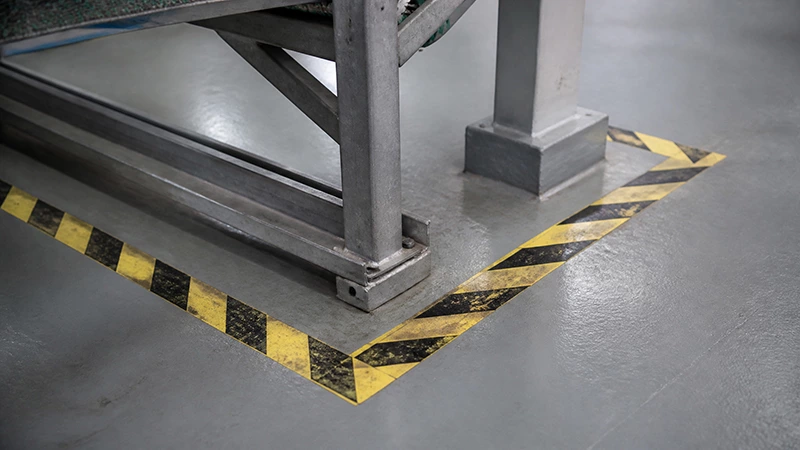
| Yellow-and-black zebra tape | Physical obstacles, protruding equipment, and selected hazard zones | Draw attention to potential hazards |
| Red-and-white markings | Fire equipment and emergency access areas | Keep emergency facilities accessible |
| Orange markings | Pending-inspection or temporary staging areas in some factories | Distinguish materials awaiting a specific process |
These meanings should not be treated as a universal color code for every PCBA factory. A manufacturer should maintain a documented visual standard explaining the meaning of each marking used on its production floor.
1. Yellow Solid Lines: Traffic Aisles and Equipment Positioning
Yellow solid lines are commonly used to define traffic aisles in manufacturing facilities. They separate designated walking or material transportation routes from production and storage areas.
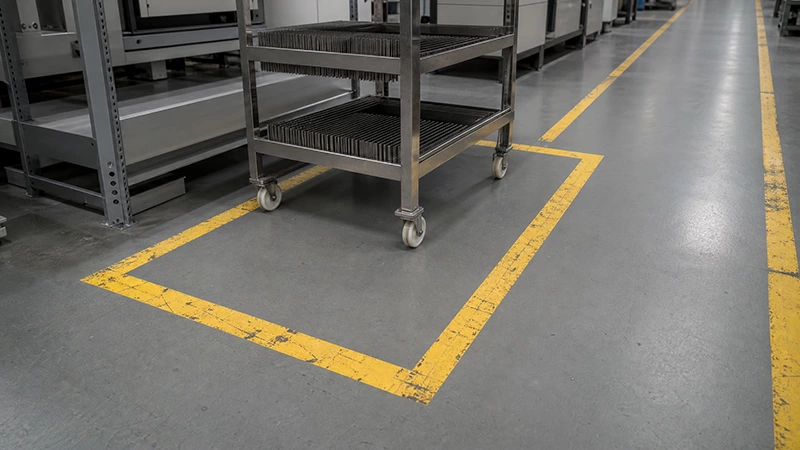
In a PCBA plant, these routes may connect:
- Raw material storage and the SMT production area
- SMT lines and through-hole assembly stations
- Production areas and functional testing stations
- Finished goods inspection and packing areas
The main rule is straightforward: designated aisles should remain clear so that personnel and material-handling equipment can move safely and efficiently.
Why Must Yellow Aisles Stay Clear?
When pallets, component carts, or finished goods are placed in an aisle, they can obstruct material movement and create unnecessary handling risks.
A blocked aisle may also force employees to move materials through an unintended route, making production flow less organized.
During a factory audit, buyers should check whether:
- Walking and transportation routes are clearly marked.
- Materials are kept within designated storage areas.
- Carts and pallets are not left in traffic aisles.
- Worn or damaged markings are repaired.
Employees understand the rules for keeping aisles clear.
Yellow lines may also be used as equipment positioning references. In this application, they help identify where a machine or production unit should be located.
Equipment positioning markings can support workplace organization by making unexpected movement or incorrect placement easier to identify. However, they should not replace the equipment installation and utility requirements specified by the manufacturer.
2. White Floor Markings: Workstation Tools and Fixtures
White floor markings may be used to define the designated positions of tools, fixtures, jigs, and other workstation items.
In an SMT or PCBA assembly area, operators may need access to different tools and production accessories during each shift. Without fixed storage locations, items can gradually move away from their intended positions.

White positioning frames help make it clear where workstation items should be stored when they are not in use.
Typical applications include:
- Workstation tools and accessories
- Assembly fixtures and jigs
- Designated equipment carts
- Other items that require fixed storage positions
These markings support workplace organization and help operators restore a workstation to its intended condition after use.
It is important to understand that a white positioning frame is not necessarily a safety boundary. Its meaning depends on the factory's own visual management standard.
3. Red Solid Lines: Defective Products and Restricted Areas
Where a factory uses red for nonconforming material, this is an internal visual-management convention rather than a safety colour requirement under regulations such as OSHA 1910.144.
Red solid lines may be used to identify restricted or controlled areas, including defective-product storage and designated hazardous chemical storage areas.
These areas require clear identification because uncontrolled material movement can create quality or safety problems.
Defective-Product Areas
During PCBA manufacturing, products may be identified as nonconforming after incoming inspection, SMT assembly, through-hole soldering, functional testing, or final inspection.
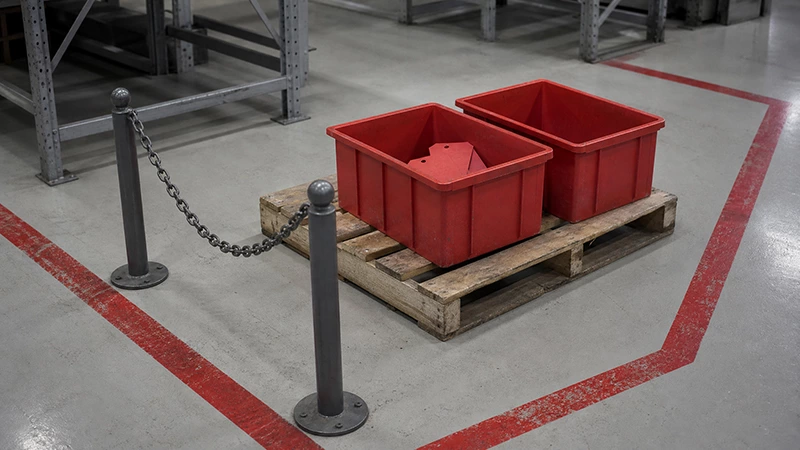
Defective products should be separated from qualified products to prevent accidental mixing or unintended release.
A clearly marked defective-product area helps establish a visible boundary for nonconforming materials.
An effective control process should also include:
- Clear nonconforming-product identification
- Restricted or controlled access where appropriate
- Defined disposition procedures
- Inspection and rework records
- Authorization before products return to the qualified production flow
Floor markings provide a physical reference, but they should be supported by product labels, quality records, and nonconformance procedures.
Hazardous Chemical Storage Areas
PCBA production may involve solder paste, flux, cleaning solvents, adhesives, and other process-related chemicals.
These materials require appropriate storage, handling, and identification according to their safety data sheets and applicable requirements.
A designated chemical storage area helps prevent unauthorized storage and uncontrolled movement of chemicals.
Depending on the materials involved, the area may also require suitable ventilation, spill control, fire protection, and access restrictions.
Red floor markings can help identify the boundary of a controlled area, but they do not replace chemical hazard labels or other required safety measures.
4. Yellow-and-Black Zebra Tape: Physical Hazards and Warning Zones
Yellow-and-black zebra tape is commonly used to attract attention to physical hazards or areas requiring additional caution.
Unlike a plain floor line, its contrasting pattern makes a potential hazard more noticeable to employees, visitors, and maintenance personnel.
In an electronics manufacturing facility, possible applications include:
Physical Obstacles
Zebra markings may be used around:
- Protruding machine frames
- Low structural beams
- Conveyor support structures
- Other fixed obstacles that could cause collisions or injuries
The marking helps make these hazards easier to recognize, particularly in areas where people regularly move materials or equipment.
High-Temperature Areas
Certain production processes involve elevated temperatures. Reflow soldering, for example, exposes PCBs to controlled thermal profiles inside the reflow oven.
Some external surfaces or nearby machine components may also become hot during operation.
Where a physical burn hazard has been identified, suitable warning markings and safety signs can help communicate the risk.
The marking boundary should be determined according to the actual equipment layout and hazard assessment. It should not be assumed that every reflow oven requires the same floor marking arrangement.
5. Red-and-White Markings: Fire Equipment and Emergency Access
Red-and-white floor markings may be used to identify areas that must remain clear around fire equipment or designated emergency access points.
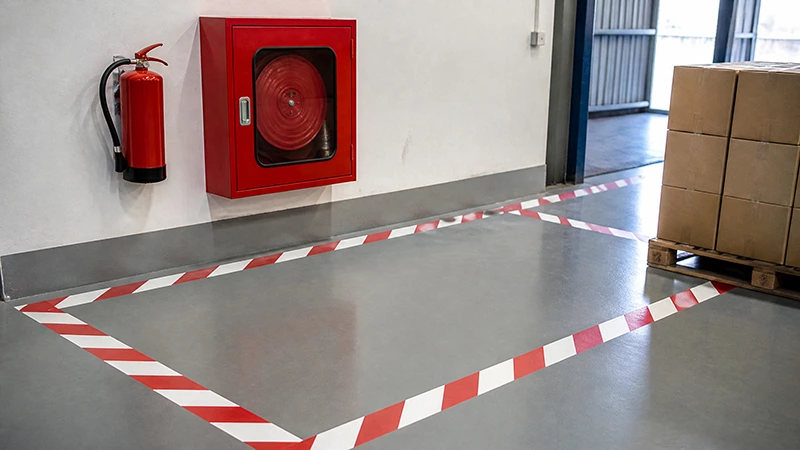
These areas should never become temporary storage locations for production materials.
Items that may obstruct access include:
- Finished goods and packaging materials
- Component boxes and empty containers
- Pallets and material carts
- Incoming shipments waiting for inspection
- Production equipment or temporary fixtures
Keeping emergency facilities accessible is an essential part of factory safety management.
During a factory audit, buyers should check whether fire equipment is visible, accessible, and free from obstruction. Emergency exits and evacuation routes should also be clearly identified according to applicable local requirements.
The precise marking pattern and color combination should follow the facility's documented safety standard and relevant regulations.
6. Orange Floor Markings: Pending-Inspection Areas
Some manufacturing facilities use orange markings to identify materials awaiting inspection or another defined process.
For example, materials may be placed in a designated waiting area before incoming inspection or quality release.

This helps prevent uninspected materials from entering production or being mixed with qualified inventory.
However, orange is not a universal marking for pending-inspection areas. Different factories may use different colors or identification methods.
The important requirement is that the status of the material is clear and that employees understand when it can be released to the next process.
A proper material control system should combine floor markings with identification labels, inspection records, and release authorization.
How Floor Markings Interact with ESD Control
An important distinction in electronics manufacturing is that a marked floor area is not automatically an ESD-protected area.
An ESD Protected Area (EPA) is established to control electrostatic discharge risks for sensitive electronic components and assemblies.
Its effectiveness depends on electrical protection measures, including appropriate grounding, suitable work surfaces, personnel grounding, and regular verification.
A yellow or white floor marking only identifies a physical boundary. It does not prove that the floor has the required electrical properties or that the equipment and work surfaces are properly connected to ground.
What Should Be Checked in an ESD Protected Area?
During an ESD audit, the following items may need to be reviewed:
- ESD floor and work surface specifications
- Grounding and bonding arrangements
- Personnel grounding procedures
- Wrist strap testing records
- Work surface resistance measurements
- ESD equipment inspection and verification records
- Employee training and compliance records
ANSI/ESD S20.20 provides a framework for establishing and maintaining an ESD control program. The applicable requirements should be evaluated according to the facility's products, processes, and ESD control plan.
The key point is to evaluate floor marking and ESD protection separately: one defines the physical area, while the other controls electrostatic discharge risks.
Common Problems That Floor Markings Help Prevent
A properly maintained floor marking system helps reduce several common problems in a PCBA factory.
| Potential Problem | Possible Consequence | How Floor Markings Help |
| Blocked traffic aisles | Delayed material movement and unsafe walking routes | Define areas that must remain clear |
| Obstructed emergency access | Delayed access to fire equipment or exits | Highlight designated emergency access areas |
| Mixed defective and qualified products | Accidental use or shipment of nonconforming products | Identify controlled defective-product areas |
| Incorrect equipment positioning | Disorganized work areas and possible process disruption | Provide visible positioning references |
| Unrecognized physical hazards | Collisions, trips, or contact with hazardous surfaces | Highlight obstacles and selected warning zones |
| Uncontrolled material staging | Materials entering production before inspection or release | Identify designated waiting areas |
| Confusion between ESD and non-ESD areas | Inadequate electrostatic discharge control | Make physical boundaries visible while ESD compliance is verified separately |
Floor markings are most effective when they are supported by clear operating procedures, employee training, and regular inspection.
A Buyer's Audit Checklist for PCBA Factory Floor Markings
When evaluating a PCB assembly manufacturer, buyers can include floor marking checks as part of their factory audit.
The following checklist provides a practical starting point.
1. Check the Main Traffic Aisles
- Are the main walking and material transportation routes clearly marked?
- Are pallets, component carts, and finished products kept out of designated aisles?
- Are floor markings visible and properly maintained?
2. Check Emergency Access Areas
- Are fire extinguishers, hydrants, and other emergency facilities accessible?
- Are emergency exits and evacuation routes free from obstruction?
- Do floor markings match the facility's safety requirements?
3. Check Defective-Product Areas
- Are nonconforming products physically separated from qualified products?
- Are defective materials clearly identified?
- Is there a documented process for inspection, rework, and disposition?
4. Check Chemical Storage Areas
- Are chemicals stored in designated locations?
- Are containers properly labeled?
- Are storage and handling procedures consistent with the relevant safety requirements?
5. Check Hazard Warning Areas
- Are physical obstacles and identified hazards clearly marked?
- Are warning markings visible around relevant equipment?
- Are safety signs and operating procedures available where required?
6. Check ESD Protection Separately
- Is the ESD Protected Area clearly identified?
- Are grounding arrangements documented?
- Are personnel grounding and work surface verification records available?
7. Review the Visual Management Standard
- Does the factory have a documented floor marking standard?
- Do the actual markings match the documented requirements?
- Are damaged or faded markings repaired promptly?
- Do employees understand what each marking means?
A factory with clear floor markings and consistent implementation demonstrates a more organized approach to workplace management. However, the markings should always be evaluated together with actual operating practices and supporting records.
Frequently Asked Questions About PCBA Factory Floor Marking Colors
What does a yellow line mean on a factory floor?
A yellow solid line commonly identifies a traffic aisle or designated equipment position. In a PCBA factory, it may define the route used by personnel and material-handling equipment. The exact meaning depends on the factory's internal visual management standard.
What does yellow-and-black zebra tape mean?
Yellow-and-black zebra tape commonly warns of physical hazards or areas requiring caution. It may be used around protruding equipment, structural obstacles, or identified high-temperature zones.
What does red-and-white floor marking mean?
Red-and-white markings may identify fire equipment locations or designated emergency access areas. These spaces should remain clear so that emergency facilities can be accessed without obstruction.
What does a red line mean on a factory floor?
A red solid line may identify a restricted or controlled area, such as a defective-product storage area or designated hazardous chemical storage area. The exact application should be defined by the factory's own visual standard.
What does a white floor marking mean in an electronics factory?
White floor markings may define the designated positions of tools, fixtures, jigs, and other workstation items. They are often used as positioning references rather than safety boundaries.
What does an orange floor marking mean?
Some factories use orange to identify materials awaiting inspection or another defined process. However, this is not a universal convention, so the local visual management standard should always be checked.
Are factory floor marking colors regulated?
Safety color requirements vary by jurisdiction and application. For example, OSHA 29 CFR 1910.144 addresses specific safety color meanings in US general industry. It should not be interpreted as a universal color code for every floor marking used in a PCBA factory.
Manufacturers should follow applicable local regulations and maintain a documented internal standard that explains their actual floor marking system.
Are floor markings enough to prove ESD compliance?
No. Floor markings only identify physical areas. ESD compliance requires appropriate electrostatic discharge control measures, grounding arrangements, and verification records under the facility's ESD control program.
The Role of Floor Markings in PCBA Factory Management
Floor markings provide a simple but important visual reference for managing space, material movement, equipment positions, restricted areas, and workplace hazards.
In a PCBA manufacturing facility, they help keep production aisles clear, separate nonconforming products, identify controlled storage areas, and make potential hazards easier to recognize.
However, a painted line or strip of floor tape alone does not guarantee effective management. Its value depends on whether the marking system is clearly documented, regularly maintained, understood by employees, and consistently followed.
At TECOO, visual management is considered part of organized electronics manufacturing across production, assembly, and testing operations. Customers evaluating TECOO for industrial control, security electronics, automotive electronics, medical electronics, or home appliance projects are welcome to learn more about our manufacturing processes and quality management approach.
Contact TECOO to discuss your PCBA manufacturing requirements and supplier audit needs.