PCBA Tote Box & Tray Colors: What Red, Yellow, Green, Blue and Black Mean
Introduction: What Do PCBA Tote Box Colors Mean?
In a PCBA factory, tote boxes, bins and trays help organize printed circuit boards (PCBs), electronic components and work-in-progress (WIP) materials throughout the production process. Their colors can provide quick visual cues about material status, handling requirements or intended use.
However, there is no universal international color code that requires every PCBA factory to use the same colors for the same purposes. A red container may indicate defective material in one factory, while another facility may use a different color scheme. The factory's documented procedures determine what each color means.
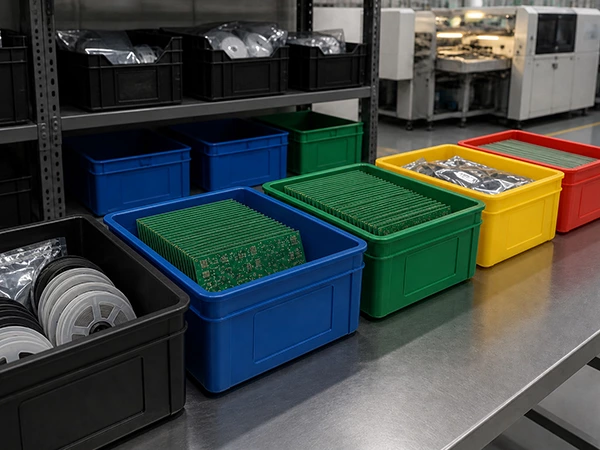
In some manufacturing environments, red is used for defective or rejected material, yellow for items awaiting inspection or disposition, green for accepted material, and blue for normal production flow or work in progress. Black containers may be selected for specific handling requirements, including ESD control or light protection, depending on their material and design.
For buyers and supplier quality engineers, understanding a factory's color-coding system is more than a matter of visual organization. It helps reveal how the factory identifies material status, prevents mix-ups and controls product movement.
This article explains five commonly encountered container colors, the risks that color-coded systems are designed to reduce, and what to check when auditing a PCBA supplier.
Quick Answer: What Do Red, Yellow, Green, Blue and Black Containers Mean?
The following table shows examples of how these colors may be used in electronics manufacturing. They are illustrative conventions, not universal requirements.
| Container Color | Possible Use | What to Verify |
| Red | Defective, rejected or scrap material | Is the material clearly identified and controlled to prevent unintended reuse? |
| Yellow | Material awaiting inspection, rework or disposition | Is the pending decision documented, and is movement restricted where required? |
| Green | Accepted or passed material | Is acceptance supported by inspection or test records? |
| Blue | Normal WIP, raw material or boards awaiting a production step | Does the factory define the intended material status clearly? |
| Black | Dedicated handling for specific components or applications | Are ESD, light protection and other requirements verified independently of color? |
Important: Color is a visual aid, not proof of product quality, inspection status or ESD protection. Labels, documented procedures and the factory's applicable production records provide the evidence needed to confirm material status.
Why Do PCBA Factories Use Color-Coded Containers?
PCBA manufacturing involves multiple material states and process stages. Bare boards may be waiting for SMT assembly, assembled boards may be awaiting inspection, and nonconforming products may require rework or formal disposition.
When containers look similar, operators must rely on labels, paperwork or system records to identify their contents. If identification is unclear or difficult to read, the risk of selecting the wrong material or moving a product to the wrong process increases.
A well-designed color-coding system provides an additional visual control. Operators can recognize a container's intended use quickly, even when they cannot immediately read its label.
Three elements should work together:
1. Color: A Quick Visual Cue
Color helps operators distinguish categories of material at a glance. For example, a factory may use red containers for rejected products and green containers for accepted products.
The meaning must be defined in the factory's procedures and communicated consistently to relevant employees.
2. Label: Clear, Traceable Identification
A container label should provide the information needed to identify and handle its contents correctly. Depending on the process, this may include:
- Part number or product model
- Work order, lot or batch number
- Quantity
- Current material status
- Inspection or disposition status
- Date and responsible person, where applicable
The label should agree with the actual contents and the documented status. A green container does not make an untested board acceptable, and a red container does not replace the need to identify the defect or disposition.
3. Production Records: Evidence of Status and Movement
Factories may use an MES (Manufacturing Execution System), ERP system, traveler or other production records to track material status and movement.
At factories using MES, the system can provide an electronic record of material status and process progression, while physical labels help identify the material on the shop floor.
The exact control method varies by factory. The key requirement is that the container, label and applicable production records should not contradict one another.
This layered approach helps reduce the risk of material mix-ups and makes production control easier to verify during a supplier audit.
Red Containers: Defective, Rejected or Scrap Material
In some PCBA factories, red containers are designated for defective, rejected or scrap material. The objective is to make nonconforming products easy to recognize and prevent them from being mistaken for acceptable production stock.
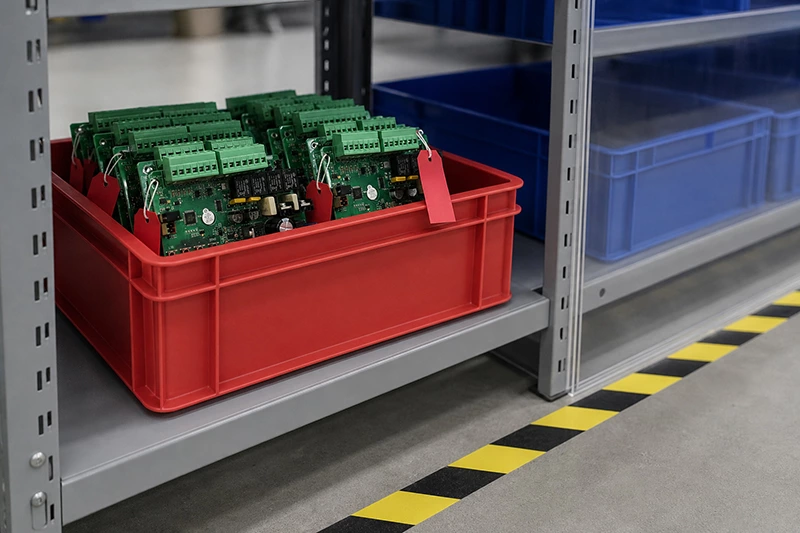
For example, a PCBA may fail an inspection because of a soldering defect, a missing component or another nonconformity. Depending on the defect and the applicable procedure, the board may need rework, further evaluation or formal scrap disposition.
A red container can provide a visible warning that the material requires controlled handling. However, the color alone does not establish whether a board is repairable or must be scrapped.
What Good Red-Container Control Looks Like
- The contents are clearly identified.
- The defect or nonconforming status is documented.
- Rework, return-to-production or scrap decisions follow an approved procedure.
- Access and movement are controlled where necessary.
- Material cannot be returned to normal production simply because it has been placed in another container.
Where a factory uses a dedicated nonconforming-material area, red containers should be managed consistently with that area's segregation and identification procedures.
What Can Go Wrong?
If a rejected PCB is placed among accepted products, an operator may unknowingly send it to the next process. The defect may then escape detection until a later inspection, functional test or customer evaluation.
The purpose of the red-container system is therefore not simply to identify a problem. It is to support effective control of nonconforming material.
During an audit, check whether the container's contents, label and disposition records agree. Also ask how the factory prevents reworked or rejected products from returning to normal production without the required authorization.
Yellow Containers: Material Awaiting Inspection or Disposition
Yellow may be used to identify material that requires a decision before it can proceed. Depending on the factory's procedures, this may include products awaiting inspection, material under review, or boards awaiting rework or disposition.
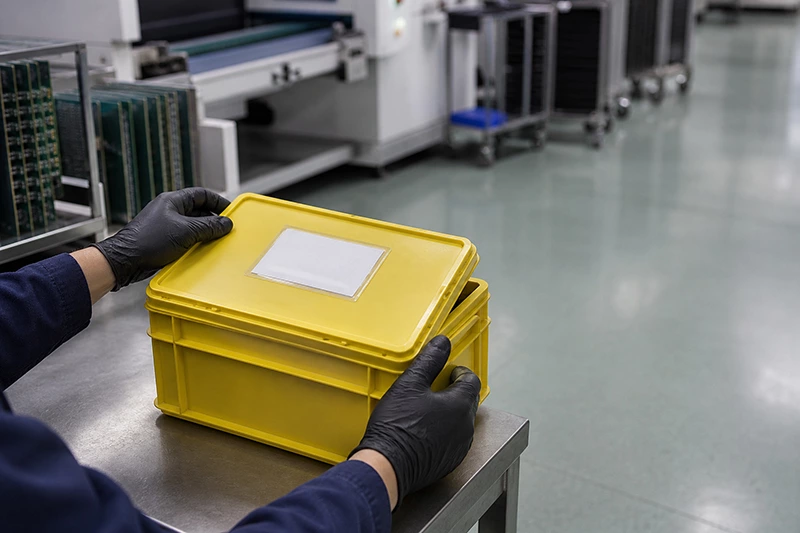
The defining characteristic is pending status. The next action has not yet been fully authorized or completed.
For example, if an assembled PCB has an uncertain inspection result, the factory may hold it for additional evaluation. A clearly identified pending-status container helps prevent the board from being treated as an accepted product before the decision is made.
What Good Yellow-Container Control Looks Like
- The reason for the hold is recorded.
- The responsible person or function is identified.
- The required inspection or decision is clear.
- Material movement follows the applicable hold procedure.
- The status is updated when the decision is completed.
A yellow container should not become a permanent storage location for products whose status nobody can explain. Unresolved material needs an owner and a defined next step.
What Can Go Wrong?
If pending material is mixed with accepted WIP, an operator may assume that it has already passed inspection. This can result in premature process movement, incomplete rework or the use of material that has not been released.
During a supplier audit, select a pending-status container and ask: What decision is outstanding? Who is responsible? What evidence is required before this material can move forward?
A clear answer indicates that the color system is connected to an actual control process rather than being used only for visual organization.
Green Containers: Accepted or Passed Material
Green may be used to identify material that has met the applicable acceptance criteria and is authorized to proceed to the next designated step.
For example, a PCB assembly that has passed the required inspection may be transferred to an area for the next production operation. A green container can help operators distinguish it from material awaiting inspection or requiring corrective action.
However, green should indicate a defined status, not simply that a product looks normal. The acceptance decision must be supported by the relevant inspection, test or production records.
What Good Green-Container Control Looks Like
- The factory has defined what green means.
- Acceptance is based on the applicable inspection or test criteria.
- The material and its identification label agree.
- Products with unresolved defects are not treated as accepted.
- Empty or unused green containers are managed so they cannot be mistaken for containers holding released material.
Watch for Unclear Status Identification
A container's color may be correct while its contents are not. For example, a rejected board could be mistakenly placed in a green container, or a container could retain an outdated label after its contents have changed.
This is why visual identification must be supported by accurate labeling and status verification.
During an audit, do not rely on the container color alone. Select a sample and trace its status back to the applicable inspection or test evidence.
Blue Containers: Raw Material, Bare Boards or Work in Progress
Blue may be used in some factories for normal material flow, raw materials, bare PCBs awaiting assembly or other work-in-progress categories.
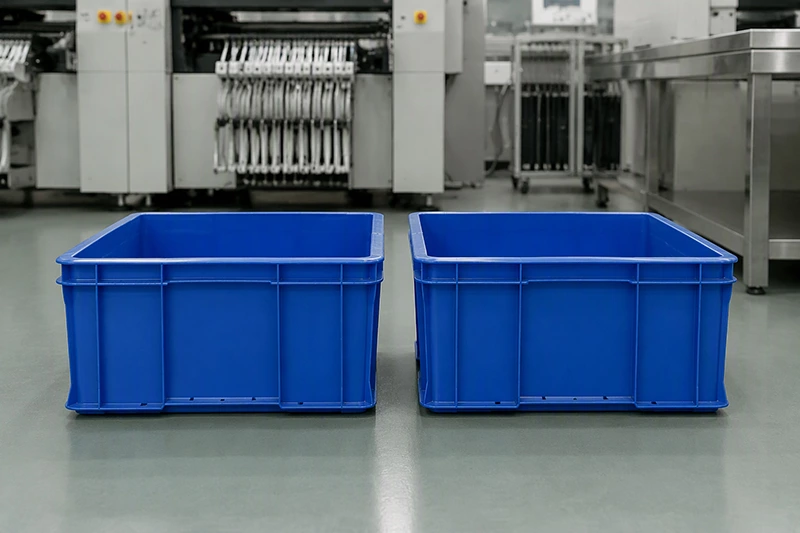
Its meaning depends on the factory's own system. Blue does not universally mean WIP, and it does not automatically indicate that the container is suitable for ESD-sensitive products.
A clear definition is particularly important when multiple types of material are handled in the same production area.
What Good Blue-Container Control Looks Like
- The factory defines which material categories may be stored in blue containers.
- Material is identified by part number, lot or work order as applicable.
- Different product types are not mixed without authorization.
- The container is suitable for the material and handling conditions.
- ESD requirements are verified separately when the contents are ESD-sensitive.
Why Blue Does Not Automatically Mean ESD-Safe
Two blue containers can look almost identical but have different electrical properties. One may be made from an ESD-control material, while another may be an ordinary plastic container.
Color alone cannot establish whether a container provides the required ESD protection.
When a container is intended for ESD-sensitive assemblies or components, verify its specification and suitability for the factory's ESD control program. Where applicable, review material documentation and surface-resistance or other required test records.
This distinction matters because electrostatic discharge can damage sensitive electronic devices, sometimes without visible signs of damage.
During an audit, ask the supplier to identify which containers are designated for ESD-sensitive materials and how their suitability is verified. Also check whether ordinary containers can be confused with ESD-controlled ones.
Black Containers and Trays: Verify the Actual Handling Requirement
Black containers and trays may be used for dedicated component handling in some electronics factories. Depending on the design and application, the selection may relate to ESD control, opacity, component handling or other process requirements.
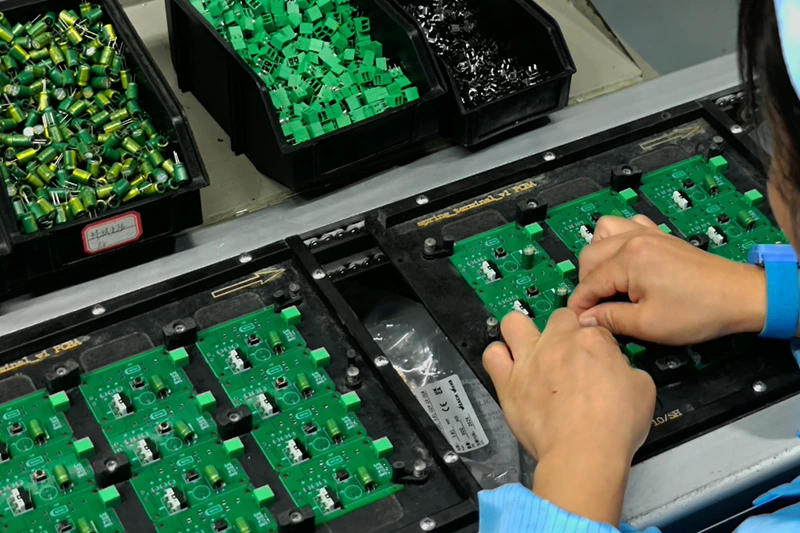
However, black is not a universal status color or a technical specification. A black tray is not automatically ESD-safe, light-blocking or suitable for moisture-sensitive devices.
The container's material, design, specification and intended use must be verified independently of its color.
ESD Control and Light Protection Are Different Requirements
ESD control concerns the management of electrostatic charge and discharge risks. Light protection, by contrast, may be required for components that are sensitive to particular light conditions.
These are separate properties. A container designed to provide one type of protection does not necessarily provide the other.
If a black tray is used for ESD-sensitive components, confirm that its documented properties are appropriate for the intended application. If light protection is required, verify that the tray provides the specified protection under the relevant handling conditions.
Do not assume that the color itself proves either property.
What About BGA, QFN and Moisture-Sensitive Devices?
BGA (Ball Grid Array) and QFN (Quad Flat No-lead) describe electronic package types. Some devices supplied in these and other surface-mount packages may be moisture-sensitive, but package type alone does not establish the applicable Moisture Sensitivity Level (MSL).
For moisture-sensitive devices, the relevant requirements depend on the device's classification and the applicable handling procedure. IPC/JEDEC J-STD-033 addresses the handling, packing, shipping and use of moisture/reflow-sensitive surface-mount devices, including controls related to floor life, dry storage and baking or recovery where required.
A black tray does not establish an MSL classification and does not replace moisture-sensitive device controls.
What Should Buyers Check?
When auditing a supplier's dedicated trays or component containers, ask:
- What specific handling requirement is this tray designed to meet?
- Is there a material or product specification supporting that use?
- If ESD control is required, what verification records are available?
- If the component is moisture-sensitive, how is its MSL and floor life controlled?
- Are the tray and its contents identified and handled according to the applicable procedure?
These questions help distinguish a genuine material-handling control from a color convention that has no verified technical meaning.
What Can Go Wrong When Container Color Coding Is Poorly Controlled?
Color coding is useful only when it is consistent with the actual material status and the factory's documented procedures. The following examples illustrate common risks that buyers should consider during a PCBA supplier audit.
| Potential Failure | Why It Matters | What to Check |
| Rejected material returns to production | Defective boards may be processed or shipped unintentionally | Segregation, identification and disposition records |
| Pending material advances too early | Inspection or corrective action may be incomplete | Hold status, decision owner and release authorization |
| Accepted status is assumed from color alone | Unverified products may be treated as conforming | Inspection and test evidence |
| Ordinary containers are used for ESD-sensitive products | The container may not provide the required ESD-control properties | Container specifications and verification records |
| Moisture-sensitive devices are handled incorrectly | Exposure beyond permitted conditions may cause damage during reflow, including moisture-induced cracking sometimes called "popcorn" failure | MSL classification, floor-life tracking and applicable storage procedures |
| Scrap is returned to usable stock | Material may be reused without proper authorization | Scrap identification, access control and disposition records |
| Mixed batches lose traceability | Product identity and process history may become unclear | Lot identification, labeling and traceability procedures |
A mature factory does not depend on color alone to prevent these failures. It combines visual identification with material segregation, traceability, inspection, testing and controlled process movement.
PCBA Supplier Audit Checklist: How to Evaluate Container Control
For overseas buyers, procurement teams and supplier quality engineers, container management can provide useful evidence of how a factory controls material on the production floor.
Use the following checklist during a factory visit or supplier audit.
1. Ask What Each Color Means
Ask an operator to explain the meaning of the colors used in the production area.
Compare the answer with the factory's documented procedures or visual-management instructions. If different employees give conflicting explanations, the system may not be sufficiently standardized or communicated.
2. Check Nonconforming-Material Control
Find the area or containers designated for rejected or nonconforming products.
Check whether the material is identified, whether its status is documented, and whether the process for rework, return to production or scrap is clear.
The exact physical arrangement may vary by factory, but the controls should prevent unintended use.
3. Inspect Pending-Status Material
Select a container holding material that is awaiting inspection, review or disposition.
Ask what decision is pending, who is responsible and what conditions must be met before the material can proceed.
If no one can explain its status or next step, investigate further.
4. Verify the Basis for Accepted Status
Choose a sample of material identified as accepted or passed.
Check whether the status can be traced to the applicable inspection, test or production record. This helps confirm that the visual indication is consistent with actual release criteria.
5. Verify ESD Container Suitability
Identify containers used for ESD-sensitive components or assemblies.
Ask for the applicable specifications and verification records. Where relevant, check that the containers are included in the factory's ESD-control procedures and are suitable for their intended use.
Do not accept color alone as evidence of ESD performance.
6. Check Moisture-Sensitive Device Controls
Where moisture-sensitive devices are used, ask how the factory identifies the applicable MSL and controls floor life, storage and handling.
Review the relevant procedures and records rather than inferring moisture sensitivity from the component package or tray color.
7. Check Empty Containers and Batch Mixing
Ask how empty containers are identified and managed. Confirm that they cannot easily be mistaken for containers holding material with a particular status.
Also ask what happens when batches, work orders or product types are mixed accidentally. The supplier should be able to explain how the affected material is identified, contained and reviewed.
8. Trace One Product Through the Process
Choose a representative PCB assembly and follow its identification from one production stage to the next.
Compare the container, label and applicable records at each step. Check whether the material status changes when required and whether the product can be traced back to its work order or lot.
This exercise often provides a more reliable view of process control than looking at the containers alone.
Frequently Asked Questions
1. Is There a Universal Color Code for PCBA Tote Boxes?
No. There is no universal international color code that requires all PCBA factories to use identical colors for material status. Individual factories define their systems through their own procedures. Buyers should confirm the supplier's documented meanings rather than assume that a particular color always has the same meaning.
2. Does a Red Tote Box Always Mean Defective PCB?
No. Red may be used for defective, rejected or scrap material in some factories, but this is not universal. Confirm the factory's procedures and check the container's label and material status records.
3. What Does a Yellow Container Mean in Electronics Manufacturing?
Yellow may identify material awaiting inspection, rework or disposition. The exact meaning depends on the factory. If the container indicates pending status, check what decision is outstanding and what is required before the material can proceed.
4. Does a Green Container Mean the PCB Has Passed Inspection?
Not necessarily. Green may be used for accepted material, but the color is only a visual cue. Acceptance should be supported by the applicable inspection, test or production records.
5. Does a Blue Bin Mean It Is ESD-Safe?
No. A blue container may be an ordinary plastic bin or an ESD-control container. Verify the actual material specification and the supplier's relevant verification records before using it for ESD-sensitive products.
6. Why Are Black Trays Used for BGA or QFN Components?
Some factories use dedicated black trays for particular components or handling applications. The reason may relate to ESD control, opacity or other requirements, depending on the tray's design. BGA and QFN are package types and are not automatically moisture-sensitive. Verify the tray specification and the component's actual handling requirements.
7. What Is the Difference Between ESD Control and Moisture-Sensitive Device (MSD) Control?
ESD control addresses risks associated with electrostatic charge and discharge. MSD control addresses the moisture-related risks of moisture-sensitive devices during storage, handling and exposure to reflow conditions. These are separate requirements and may need different controls. A container's color does not prove compliance with either one.
8. What Should I Check When Auditing PCBA Material Containers?
Start with the factory's color-coding rules, then verify labels, segregation, material status, traceability and release records. For ESD-sensitive or moisture-sensitive components, review the applicable specifications and handling procedures. The key question is whether the visual system is supported by effective process controls.
9. Are Tote Boxes, Bins and Trays the Same Thing?
Not exactly. These terms refer to different types of containers and carriers, although factories may use them for overlapping purposes. Tote boxes and bins are often used to hold or transport materials, while dedicated trays may position or protect individual components or assemblies. The correct choice depends on the material, process and handling requirements.
Key Takeaway: Color Is a Visual Control, Not Proof of Compliance
PCBA tote box and tray colors can make material status easier to recognize and help operators distinguish different categories of work in progress. In some factories, red may indicate nonconforming material, yellow pending status, green accepted material and blue normal production flow. Black containers may be used for dedicated handling applications.
These meanings are examples, not universal rules. The actual meaning of each color must be defined by the factory, and the container's color cannot independently prove product acceptance, ESD protection or moisture-sensitive device compliance.
For buyers evaluating a PCBA manufacturing partner, the more important questions are whether the factory has clear procedures, accurate labels, traceable production records, effective segregation and verified handling controls.
At TECOO, effective PCBA manufacturing depends on coordinated process control, material identification and quality verification throughout production. When evaluating a manufacturing supplier, look beyond the colors on the shop floor and confirm how the supplier manages material status, traceability and the requirements of the products being handled.
Looking for a PCBA manufacturing partner? Visit TECOO to learn more about our electronics manufacturing capabilities and quality-focused approach.
References and Further Reading
The following standards provide useful technical context for the controls discussed in this article. They address specific quality or handling requirements; they should not be interpreted as establishing a universal color code for factory containers.
- ANSI/ESD S20.20 — Requirements for establishing, implementing and maintaining an electrostatic discharge control program.
- IPC/JEDEC J-STD-033 — Handling, packing, shipping and use of moisture/reflow-sensitive surface-mount devices.
- IPC-A-610 — Acceptability criteria for electronic assemblies.
Always consult the applicable edition and the requirements relevant to your products and manufacturing process.