Component Sourcing Strategy for PCBA Mass Production
[Core Answer] Consistent PCBA mass production requires a sourcing architecture built before the first purchase order — not patched together after the first stockout. The foundation: classify every BOM line by supply risk and design criticality, dual-source Tier 1 components, maintain an audited AVL, and hold calibrated safety stock on long-lead-time items. Reactive sourcing fails at scale; structured sourcing scales.
TL;DR — 5 Key Facts
- Component shortages have repeatedly disrupted electronics production across the industry in recent years — reactive sourcing is no longer viable at mass-production scale.
- The single highest-leverage action: classify your BOM by supply risk BEFORE production kick-off, not after the first stockout.
- Dual sourcing on critical components (MCUs, power ICs, RF modules) reduces single-supplier dependency and cuts average recovery time from weeks to days.
- A 10–15% safety stock buffer on long-lead-time items (>8 weeks) prevents line stoppage without over-capitalizing inventory.
- The cheapest component that delays your production by two weeks is never the cheapest component.
What Is PCBA Component Sourcing — and Why It Breaks at Scale
PCBA component sourcing is the process of identifying, qualifying, procuring, and managing electronic components required to populate a printed circuit board assembly — from passives like resistors and capacitors to active semiconductors, connectors, and modules. At prototype scale, sourcing is straightforward: pick from authorized distributors, wait for delivery, build. At mass production, the math changes entirely.
When building 10,000 or 50,000 units per quarter, a single component with a 16-week lead time, a single-source supplier, or a counterfeit risk exposure can bring the entire line to a halt. The disruption multiplies: expedite fees, airfreight premiums, engineering time spent qualifying alternates, and — most damaging — customer delivery failures.
Component shortages have repeatedly disrupted electronics production across the industry in recent years, spanning the semiconductor crisis of 2021–2023 and its downstream inventory correction into 2024–2025. Headline shortage statistics vary widely between surveys, market segments and product categories, so any single percentage should be treated with caution. What does not vary is the underlying vulnerability: single-source dependencies, reactive BOM management and gray-market procurement remain structurally present in most supply chains today.
The solution is not to hoard inventory or diversify blindly. It is to build a sourcing architecture calibrated to your BOM's actual risk profile.
Step 1 — BOM Risk Classification
A BOM for a typical industrial PCBA contains hundreds of line items. Not all carry equal risk. The first task in any mass-production sourcing strategy is to assign each component a risk tier based on two dimensions: supply risk (how hard is it to get?) and design criticality (what happens if this part is substituted or unavailable?).
| Tier | Supply Risk | Design Criticality | Sourcing Action |
| Tier 1 — Critical | Single-source or >12-week lead time | No pin-compatible alternate; functional failure if substituted | Dual source + safety stock + quarterly review |
| Tier 2 — Managed | 2–3 qualified sources; 4–12-week lead time | Alternate exists but requires re-qualification | Approved alternate on AVL; 6–8 weeks buffer stock |
| Tier 3 — Standard | Multiple distributors; <4-week lead time | Drop-in compatible alternates readily available | JIT procurement; minimal buffer |
Typical Tier 1 items: Main microcontrollers (STM32, ESP32-series, PIC32), power management ICs with proprietary feature sets, RF modules (Zigbee, LoRa, cellular), ASICs, and any component with a single-manufacturer ecosystem dependency.
This classification exercise takes 2–4 engineering hours for a complex BOM but eliminates the most common mass-production failure mode: discovering a Tier 1 shortage after purchase orders are already placed.
Step 2 — Dual Sourcing: Building Redundancy Into the Architecture
Dual sourcing means qualifying two independent, approved suppliers for each Tier 1 component — not as a backup on paper, but as an active, tested, and maintained alternative that can be switched to within a production cycle.
Many procurement teams maintain a nominal alternate but have never run it through qualification or tested it in the actual circuit. That is not dual sourcing. That is a false safety net that fails under exactly the conditions it was designed for.
What Real Dual Sourcing Requires
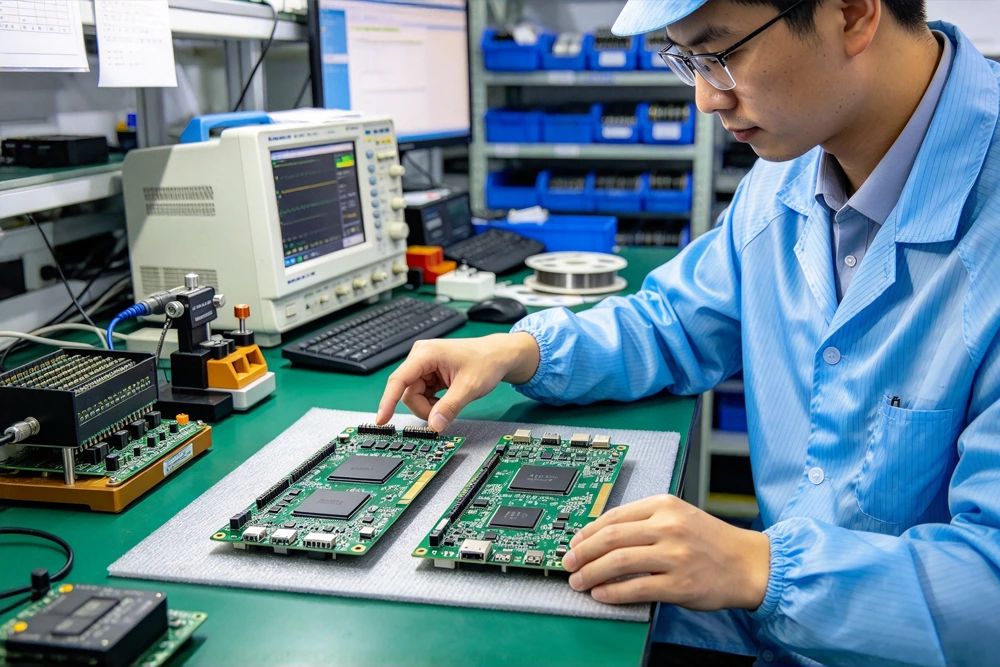
- Second-source qualification — the alternate has been assembled onto actual production boards and passed electrical, thermal, and functional test under production conditions, not just engineering samples.
- Split allocation — active split of purchase volume between primary and secondary (e.g., 70/30 or 60/40) so both relationships stay warm.
- Parametric equivalence verification — confirmed the alternate meets your design's actual operating margins, not just datasheet headline specs.
- AVL documentation — both sources listed on your Approved Vendor List with qualification evidence, so your EMS partner can procure from either without an emergency engineering review.
[RF Module Note] For RF-certified modules, dual sourcing requires verifying the alternate carries the same regional certifications (FCC, CE, IC) your product already holds. A module swap that invalidates your product certification is not an alternative — it is a new qualification project.
Step 3 — Approved Vendor List (AVL) Management
The AVL is the master record of which manufacturers and distributors are approved to supply each component in your production BOM. A well-managed AVL is one of the most undervalued assets in a mass-production supply chain.
| Field | Content |
| Manufacturer Part Number (MPN) | Primary MPN + all qualified alternates |
| Approved Manufacturers | Manufacturer names (not just distribution channels) |
| Approved Distributors | Authorized distributors only |
| Qualification Status | Qualified / In-qualification / Rejected |
| Qualification Date | Last tested date |
| Certification Notes | Product-level certifications tied to this specific part |
| Lead Time (live) | Updated quarterly from distributor quotes |
| Risk Tier | Tier 1 / 2 / 3 per BOM classification |
AVL discipline enforces one hard rule: no component enters production unless it appears on the AVL with Qualified status. This single rule prevents gray-market parts, engineering shortcuts, and last-minute substitutions that cause field failures months later.
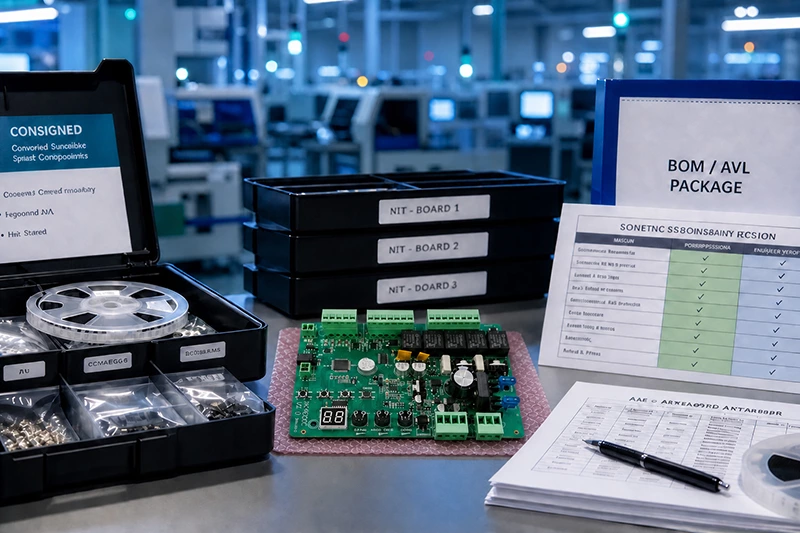
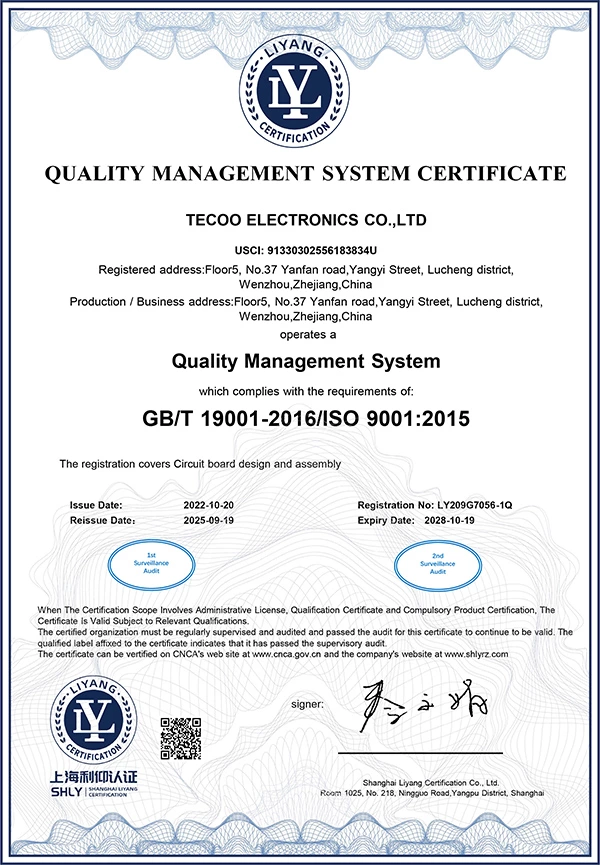
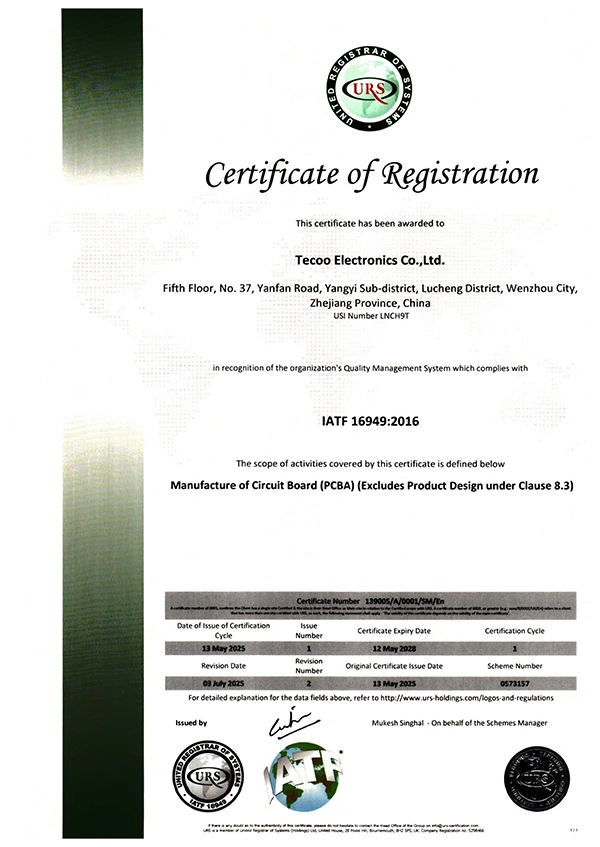
Regulatory basis: Per ISO 9001:2015 Clause 8.4 and IATF 16949:2016, maintaining a documented and controlled AVL is a formal quality management requirement for manufacturers supplying automotive, medical, or industrial customers.
Step 4 — Safety Stock Calculation
Safety stock is the inventory held beyond cycle-stock to absorb demand spikes and supply delays. The challenge is calibrating it: too little and production stops; too much and capital locks into components that may go obsolete or suffer MSL degradation in storage.
Safety Stock Formula
[Formula] Safety Stock = Z x sigma(lead time) x Average Daily Usage
Where: Z = service level factor (1.65 for 95%, 2.05 for 98%, 2.58 for 99%); sigma(lead time) = standard deviation of supplier lead time variability (track from 6+ months of POs); Average Daily Usage = production rate converted to daily component consumption.
- For Tier 1 components with high lead-time variability, add a 10–15% volatility buffer above calculated safety stock.
- For components sourced internationally with 15–25 day transit times, build in at least 4 additional weeks of buffer.
- Minimum review cycle: quarterly for Tier 1, semi-annually for Tier 2.
- Recalculate whenever production volume forecast changes by more than 20%.
Step 5 — Authorized Sourcing and Counterfeit Prevention
Counterfeit electronic components are a documented, well-evidenced problem. A U.S. Senate Armed Services Committee investigation identified approximately 1,800 cases of suspect counterfeit parts in the defense supply chain — more than one million components in total — and the Semiconductor Industry Association has estimated that counterfeits cost U.S. semiconductor companies over $7.5 billion in lost revenue annually. In PCBA production, failure modes range from early field failures (counterfeit capacitors with incorrect ESR) to complete functional failure at delivery.
Highest-Risk Sourcing Channels
- Open-market brokers with no manufacturer authorization
- Spot-market platforms during shortage periods (when authentic supply is constrained, counterfeit supply surges)
- Unverified online marketplaces for commodity components
Incoming Inspection Protocol for Counterfeit Prevention
- Certificate of Conformance (CoC) — request and archive for every purchase lot
- Country of Origin documentation — especially relevant for components subject to trade compliance
- Date code consistency check — mixed date codes from a single lot are a red flag
- Visual inspection under magnification — check for sanding marks (remarking), inconsistent fonts, pin finish
- Electrical parametric screening — spot-test key parameters on Tier 1 components at incoming
- X-ray inspection for BGAs and QFNs — verifies die presence and ball geometry without destructive testing
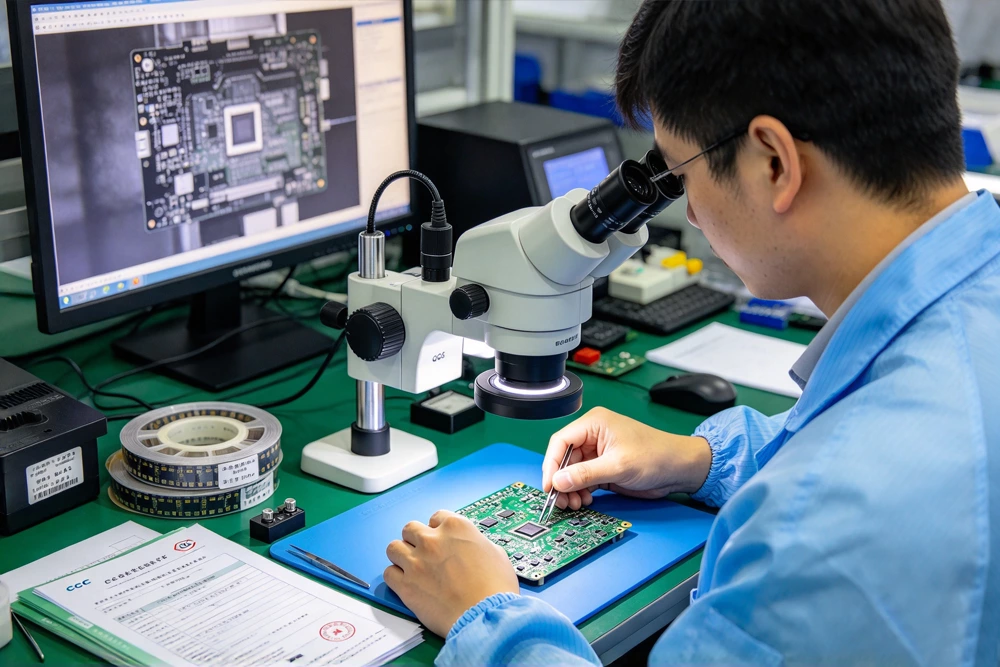
Standard reference: IPC-1752A Materials Declaration Management Standard, Amendment 3 (March 2025) provides the framework for material declaration and supply chain traceability supporting counterfeit prevention at scale.
Step 6 — Turnkey vs. Consignment: Choosing the Right Model
How you allocate sourcing responsibility between your team and your EMS partner directly affects cost, quality, and risk. There is no universally correct answer — the right model depends on your procurement infrastructure, BOM cost ownership preferences, and certification constraints.
| Dimension | Turnkey (EMS sources all) | Consignment (Customer provides) | Hybrid |
| Cost efficiency | EMS volume pricing often lower than customer pricing | Customer controls BOM cost directly | Mix: customer controls critical parts; EMS sources commodities |
| Supply chain risk | EMS carries AVL risk; customer trusts EMS quality | Customer owns risk; EMS has no component liability | Shared — define clearly in contract |
| Lead time | EMS buffers from inventory; faster response | Customer procurement adds to production schedule | Partial buffer via EMS commodity stock |
| Counterfeit risk | EMS with certified AVL reduces exposure | Customer sourcing quality varies | EMS authorized for commodities; customer controls Tier 1 |
| Best fit | Customers without in-house procurement | Customers with strong supplier relationships | High-volume OEMs with mixed BOM complexity |
For most industrial IoT OEMs scaling to mass production for the first time, hybrid sourcing delivers the best balance: EMS manages passives, standard logic, and commodity connectors; the OEM controls Tier 1 semiconductors and RF/wireless modules tied to product certifications.
Questions to Ask Your EMS Partner Before Production
- What is your AVL structure, and how frequently is it updated? (Quarterly minimum is the standard.)
- Which distributors are you authorized to source from? (Should be contractually specified, not assumed.)
- How do you handle Tier 1 shortages mid-production? (Look for a documented escalation process, not a verbal commitment.)
- What incoming inspection protocol do you apply? (Minimum: CoC review, visual inspection, parametric screening for Tier 1.)
- Do you provide component traceability reports per production lot? (Required for industrial and regulated applications.)
Five Sourcing Failures That Account for Most Production Disruptions
| Failure Pattern | Root Cause | Prevention |
| BOM locked at sample pricing, not re-validated for mass production | Prototype team finalizes BOM without volume availability check | Re-quote BOM cost and lead time at production volume before tooling commitment |
| Single-source Tier 1 with no qualified alternate | Dual sourcing treated as procurement task, not design constraint | Make Tier 1 dual sourcing a design requirement; qualify alternates before MP |
| Spot-market sourcing during shortage without enhanced inspection | Pressure to keep line running overrides incoming inspection | Contractually require CoC + parametric screening for any non-authorized-channel purchase |
| Safety stock not recalculated when production ramps | Buffer set at launch volume, never updated | Recalculate safety stock whenever production forecast changes >20% |
| No obsolescence monitoring process | No formal lifecycle tracking; EOL surprises procurement | Subscribe to manufacturer PCN/EOL alerts; plan last-time buy with 12-month lead |
FAQ
1. What is PCBA component sourcing?
PCBA component sourcing is the process of identifying, qualifying, and procuring all electronic components needed to assemble a printed circuit board. It covers passives, active semiconductors, connectors, RF modules, and any parts in the BOM, and includes supplier selection, AVL management, lead time planning, and counterfeit prevention.
2. What is an Approved Vendor List (AVL) in PCBA production?
An AVL is a controlled, documented list of manufacturers and distributors approved to supply components for a specific product BOM. Each entry records the manufacturer part number, approved alternates, distributor channels, qualification status, and last-tested date. No component should enter production unless it appears on the AVL with Qualified status.
3. How does dual sourcing protect PCBA mass production?
Dual sourcing qualifies two independent, tested suppliers for each critical component so production can continue if one source is disrupted. It requires active volume split between both suppliers, completed qualification of the alternate on real production boards, and both sources listed on the AVL — not just a paper backup.
4. How much safety stock should I hold for PCBA production?
Calculate using: Z x sigma(lead time) x Average Daily Usage, then add a 10–15% buffer for Tier 1 components. For internationally sourced components with 15–25 day transit times, add at least 4 additional weeks. Review targets quarterly or whenever production volume changes by more than 20%.
5. How do I prevent counterfeit components in my PCBA supply chain?
Source exclusively from authorized distributors with manufacturer-franchised relationships. For every purchase lot, collect a Certificate of Conformance and verify date code consistency. Apply visual inspection, parametric screening on Tier 1 components, and X-ray inspection for BGA and QFN packages. Avoid open-market brokers especially during shortage periods.
6. What is the difference between turnkey and consignment PCBA sourcing?
In turnkey sourcing the EMS partner procures all components; in consignment the customer provides them. Hybrid sourcing — the most common model for industrial OEMs — has the EMS source commodities while the customer controls Tier 1 semiconductors and certified RF modules.
7. What causes component shortages in PCBA production?
The most common causes: single-source dependency on specialty semiconductors, inadequate safety stock for long-lead-time components, late BOM finalization that reduces procurement lead time, and geopolitical or logistics disruptions. Proactive BOM risk classification and dual sourcing address the structural causes; safety stock absorbs short-term disruption.
References
- U.S. Senate Committee on Armed Services — Senate Armed Services Committee Releases Report on Counterfeit Electronic Parts (May 2012): armed-services.senate.gov
- Sierra Circuits — PCB Component Sourcing and Stocking: protoexpress.com
- IPC — IPC-1752A Materials Declaration Management Standard, Amendment 3 (March 2025): ipc.org
- ISO 9001:2015 Clause 8.4 — Control of Externally Provided Processes: iso.org
- McKinsey — Semiconductor Procurement and the Rise of AI (2024): mckinsey.com
- ScienceDirect — The Global Semiconductor Chip Shortage: Causes, Implications and Strategies (IFAC-PapersOnLine, 2022): sciencedirect.com
- IPC China — IPC Standard Update, February 2026: ipc.org.cn