PCBA Packaging for Sea Freight: Moisture Protection, ESD Control and Testing
Introduction: Why Does PCBA Packaging Matter for Sea Freight?
PCBA packaging for sea freight is a product-specific protection system designed to reduce the risks of electrostatic discharge (ESD), moisture exposure and mechanical damage during transportation. Unlike short-distance deliveries, ocean shipments may expose electronic assemblies to extended transit times, changing temperatures, high humidity, container condensation, vibration and stacking loads.
For electronics manufacturers, distributors and overseas buyers, choosing the right packaging is not simply a matter of selecting bags and cartons. The packaging configuration should reflect the assembly's components, moisture sensitivity, mechanical design, expected shipping conditions and destination handling requirements.
A practical PCBA export packaging plan may include ESD-protective materials, moisture barrier bags (MBBs), desiccants, humidity indicator cards (HICs), cushioning, corrugated cartons and appropriate pallet or container-loading controls. Not every shipment requires the same combination. The correct specification depends on the product and the risks it must withstand.
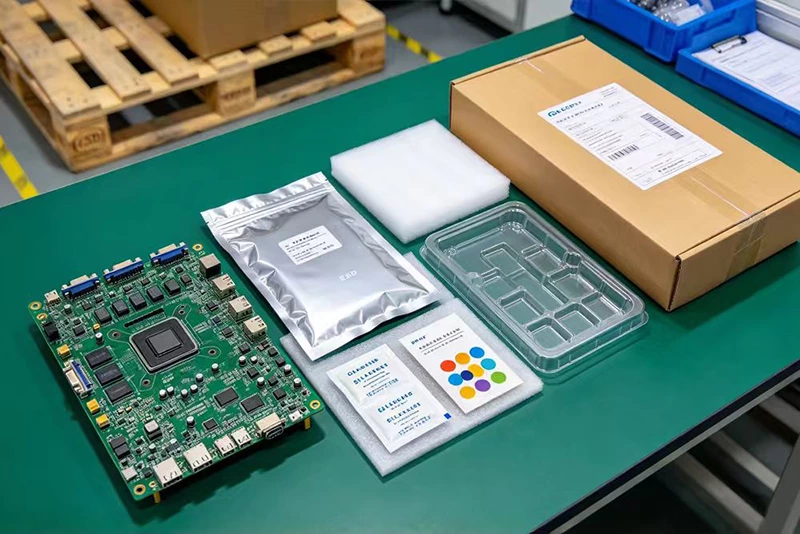
Three questions should guide the packaging decision:
- ESD protection: How will the assembly be protected against electrostatic discharge during packing, transport and unpacking?
- Moisture protection: Do the components require moisture-sensitive device (MSD) controls, and how will the package limit moisture exposure?
- Mechanical protection: Can the complete package protect the assembly against expected vibration, shock, compression and handling?
This guide explains the purpose of each protection layer, the relevant standards, the documentation buyers should request and the questions to ask when qualifying an EMS supplier for bulk PCBA shipments.
Why Sea Freight Creates Different Packaging Risks
Sea freight can expose electronics to a different combination of risks from air freight or local road transportation. The actual exposure depends on the route, season, container condition, cargo configuration, port dwell time and inland transportation.
1. Temperature and Humidity Changes
A container may travel through regions with different temperature and humidity conditions. Changes in the surrounding environment can affect the temperature of the container walls, the moisture in the cargo and the relative humidity of the air inside the container.
When a surface cools below the dew point of the surrounding air, condensation can form. This phenomenon is commonly known as container sweat or container rain.
Condensation may occur even when the container has no obvious leak. Moisture may come from the air trapped during loading, the cargo itself, packaging materials or other sources of moisture inside the container.
For electronic assemblies, the risk depends on the packaging system and whether the boards or components are exposed to moisture.
2. Electrostatic Discharge During Handling
ESD risks do not disappear once a PCBA leaves the production line. Assemblies may be handled during packing, warehouse storage, customs inspection, transportation and receiving inspection.
The packaging must be appropriate for the ESD sensitivity of the product and consistent with the applicable ESD control programme.
A bag described simply as "anti-static" should not automatically be treated as a moisture barrier or as suitable for every ESD-sensitive application. The packaging specification should identify the properties required for the intended use.
3. Vibration, Shock and Compression
Electronic assemblies can be damaged by impact, repeated vibration, contact between boards, excessive movement inside cartons or loads imposed by stacking.
Tall components, heavy connectors, heatsinks and fragile mechanical interfaces may require additional support or separation.
The packaging design should therefore consider the complete shipping configuration rather than the outer carton alone.
The Main Layers of PCBA Export Packaging
A robust packaging plan combines complementary protective measures. Each measure addresses a different risk, and the exact configuration should be selected for the product and shipping environment.
Layer 1: ESD-Protective Packaging
ESD-protective packaging helps reduce the risk of electrostatic damage during handling and transportation.
The appropriate material depends on the assembly's sensitivity, the packaging environment and the protection required. Options may include ESD-protective bags, shielding bags and other packaging materials designed for electronic components or assemblies.
The term "anti-static bag" is not sufficiently specific for a packaging specification. Different bags can have different electrical properties and levels of protection.
When reviewing an EMS supplier's packaging plan, ask for the bag specification and confirm that the selected material is suitable for the intended application. The supplier's ESD controls should also cover relevant handling and packing operations.
ANSI/ESD S20.20 and IEC 61340-5-1 are useful references for establishing and maintaining ESD control programmes. They should not be interpreted as a requirement to use one universal bag type for every PCBA shipment.
Layer 2: Moisture Barrier Bags, Desiccants and Humidity Indicator Cards
Moisture protection becomes especially important when an assembly contains components classified as moisture-sensitive.
A moisture barrier bag is designed to limit the transmission of water vapour through the packaging material. Depending on the product and packaging specification, the dry-pack system may also include desiccant and a humidity indicator card.
These items serve different purposes:
- Moisture barrier bag (MBB): Limits moisture ingress through the packaging material.
- Desiccant: Absorbs moisture within the sealed package according to its capacity and the packaging conditions.
- Humidity indicator card (HIC): Provides a visual indication of relative humidity exposure at the card's measurement points.

The three components should be specified as part of a suitable packaging design rather than selected independently.
How Does MSL Affect Packaging?
MSL stands for Moisture Sensitivity Level. It classifies the moisture sensitivity of applicable components and is used to determine relevant handling, storage and floor-life requirements.
IPC/JEDEC J-STD-033 addresses the handling, packing, shipping and use of moisture-, reflow- and process-sensitive devices. For applicable components, its procedures help control moisture absorption and the risk of cracking or delamination during subsequent soldering or rework processes.
A component's MSL should be confirmed using the applicable classification, labeling and manufacturer documentation. Do not assume that every IC or every populated PCBA has the same moisture-handling requirement.
For assemblies containing multiple components, the packaging decision should consider the relevant component requirements, assembly process, intended storage period and destination handling plan. A packaging engineer should determine the appropriate dry-pack configuration for the actual BOM and shipping conditions.
How Should Desiccant Quantity Be Determined?
There is no single desiccant quantity that is suitable for every PCBA shipment.
The required quantity depends on factors such as the moisture barrier bag's specifications and surface area, desiccant capacity, expected storage and transit duration, and the applicable requirements for the contents.
For this reason, generic recommendations such as "one pack per board" should not replace a documented calculation or an approved packaging specification.
When qualifying an EMS supplier, ask how the desiccant type and quantity were selected. For a moisture-sensitive product, request the relevant packaging calculation or specification and confirm that it applies to the actual bag size, contents and expected storage conditions.
How Should HIC Readings Be Used?
An HIC provides an indication of relative humidity exposure at its designated indicator points. It can help the receiving team evaluate the condition of a dry-pack package when it is opened.
However, an HIC reading should not be used as the only basis for deciding whether an assembly can be reflowed, must be baked or should be rejected.
The appropriate action depends on the applicable standard, component MSL, exposure history, package condition and manufacturer requirements. If a bag is damaged or the indicator suggests excessive moisture exposure, the material should be assessed under the relevant procedure before further processing.
Recording the HIC condition at packing and receiving can support traceability and help investigate packaging-related issues.
Layer 3: Cushioning and Board Separation
Mechanical cushioning reduces the risk of damage caused by impact, vibration and movement inside the package.
Common options include:
- Foam cushioning: May be suitable for assemblies that need additional protection around protruding or fragile components, provided the material is compatible with the ESD and cleanliness requirements.
- Dedicated trays: Can maintain consistent spacing and positioning when the design is appropriate for the board's dimensions and component layout.
- Separators: May be used to prevent direct contact between boards or to organize assemblies inside a carton.
The best option depends on the product's geometry, component height, board stiffness, shipment quantity and handling conditions.
For high-density assemblies or boards with fragile connectors, the package should be reviewed for contact points and unsupported areas. For simpler assemblies, a less complex solution may be sufficient if it has been shown to provide adequate protection.
Board orientation should also be determined by the assembly design, support points and packaging validation. There is no single orientation rule that can replace an assessment of the actual product.
Layer 4: Outer Cartons and Pallet Configuration
The outer carton protects the inner packaging and helps the shipping unit withstand handling, storage and stacking loads.
Important factors include:
- Carton dimensions and gross weight
- Board and cushioning arrangement
- Corrugated material and edge-crush performance
- Closure method and sealing quality
- Pallet pattern and load distribution
- Maximum expected stacking load
- Moisture exposure and handling conditions along the route
Edge Crush Test (ECT) results can help characterize corrugated board performance, but a specific ECT value alone does not prove that a carton is suitable for every shipment. Carton design, dimensions, loading configuration and the complete package must be considered together.
Likewise, gross weight and manual-handling limits should be checked against applicable workplace safety requirements and customer or logistics-provider instructions.
For a bulk PCBA shipment, the packaging design should protect the assemblies without creating unnecessary movement, crushing or excessive packaging waste.

Container-Level Moisture Control
Dry-pack packaging protects the assemblies inside individual bags. Container-level moisture management addresses the broader environment surrounding cartons and pallets during transportation.
Depending on the cargo and route, possible measures may include suitable container desiccants, moisture-resistant cargo packaging, dry loading conditions and protective covering for palletized cargo.
These measures should be selected according to the actual risk assessment. A fixed number of desiccant hangers cannot be recommended for every container because cargo moisture, container volume, voyage duration, climate and loading conditions vary.
If container desiccants are used, verify that the product is suitable for the intended application and installed according to its instructions. Any material that could leak or contaminate the cargo should be assessed carefully.
The container should also be inspected before loading. Water ingress, damaged door seals, wet floors or evidence of previous cargo contamination may create avoidable risks.
Container-level controls and board-level dry-pack controls are complementary. Neither should be assumed to replace the other when both are needed for the shipment.
Which Standards Are Relevant to PCBA Sea Freight Packaging?
Several standards may be relevant to different parts of a PCBA export packaging plan. They serve different purposes and should be selected according to the product, shipping configuration and customer requirements.
| Standard or Reference | Primary Purpose | Practical Application |
| IPC/JEDEC J-STD-033 | Handling, packing, shipping and use of applicable moisture-, reflow- and process-sensitive devices | Review dry-pack and moisture-handling requirements for relevant components |
| MIL-PRF-81705 | Requirements for flexible, heat-sealable ESD-protective barrier materials, including applicable moisture-barrier properties | Verify that the selected bag specification matches the intended application |
| ANSI/ESD S20.20 | Establishing and maintaining an ESD control programme | Review the supplier's overall ESD controls |
| IEC 61340-5-1 | ESD protection requirements for electronic devices within an ESD control programme | Support ESD programme requirements where applicable |
| ASTM D4169 | Laboratory evaluation of shipping units against hazards associated with defined distribution cycles | Determine whether a suitable distribution test plan is appropriate for the shipping configuration |
| ISTA test procedures | Performance testing of packaged products under specified test protocols | Select a procedure that matches the package type and distribution environment |
The correct standard and test plan depend on the shipment. For example, ISTA 2A is intended for individual packaged products within its specified weight scope, while ISTA 3A addresses parcel delivery systems. Neither should be described as a universal substitute for a bulk ocean-freight packaging validation programme.
Similarly, the applicable ASTM D4169 distribution cycle and assurance level should be determined from the intended distribution environment and the relevant test requirements, rather than assuming that one cycle applies to every sea freight shipment.
Always verify the current standard edition and the specific clauses relevant to the packaging design.
How Should PCBA Export Packaging Be Validated?
Packaging validation should evaluate the complete package in a configuration that represents the intended shipment.
Depending on the programme, this may involve conditioning, vibration, shock, drop or compression tests. The applicable sequence and severity should be chosen based on the selected standard, package design, distribution hazards and acceptance criteria.
A useful validation plan should answer four questions:
- What configuration is being tested? Identify the actual board or representative product, protective bag, cushioning, carton and pallet arrangement.
- What hazards does the test represent? Select tests relevant to the expected shipping and handling environment.
- What constitutes failure? Define acceptable product condition and package condition before testing begins.
- What evidence will be retained? Keep the test plan, sample configuration, results, observations and any corrective actions.
A test of an empty carton may provide information about the carton itself, but it cannot fully represent the interaction between a populated PCBA, its cushioning and the complete shipping package.
Where the packaging design changes significantly, assess whether the previous validation remains applicable.
What Documentation Should Accompany a Bulk PCBA Shipment?
Documentation helps connect the packaging specification to the material actually shipped. It can also support investigation when a shipment arrives with damaged cartons, compromised bags or possible moisture exposure.
The required documents depend on the product, customer requirements and shipping arrangement. A practical checklist may include the following.
Product and Packaging Identification
- Product part number and revision
- Work order, batch or lot identification
- Quantity per package
- Applicable packaging specification or revision
- Packaging date and relevant identification information
Moisture-Control Records, Where Applicable
- Relevant component MSL information
- Moisture barrier bag specification
- Desiccant type and quantity
- HIC type and recorded condition at sealing, if required
- Package seal inspection or verification records
- Applicable storage and handling instructions
Shipping and Receiving Information
- Carton dimensions and gross weight
- Pallet configuration, where applicable
- Container identification and seal number, where applicable
- Relevant loading and shipment records
- Photographs or receiving inspection records when required by the customer or shipping procedure
Transport Packaging Test Records, Where Applicable
- Selected standard and test plan
- Test configuration
- Acceptance criteria
- Test report and observed damage
- Corrective actions and revalidation records, if applicable
The goal is not to create paperwork for its own sake. The records should allow the supplier and buyer to establish what packaging was specified, how the shipment was prepared and what was observed when it arrived.
How to Audit an EMS Supplier's Export Packaging
When qualifying an EMS supplier for bulk PCBA orders, buyers can use the following questions to assess whether the supplier's packaging approach is supported by documented controls.
1. How Is the ESD Packaging Material Selected?
Ask which ESD properties are required and how the selected bag or packaging material meets the specification. Confirm that the term "anti-static" is not being used as a substitute for a complete material specification.
2. How Are Moisture-Sensitive Components Identified?
Ask how the supplier identifies applicable MSL requirements and determines whether dry packing is needed. Look for evidence based on component documentation and an approved packaging specification.
3. How Is the Desiccant Quantity Determined?
Ask for the rationale or calculation supporting the desiccant type and quantity. The answer should relate to the actual packaging configuration and expected storage or transit conditions rather than a fixed quantity used for every product.
4. How Are Bags Sealed and Checked?
Ask how bag sealing is specified and verified. Where applicable, review the acceptance criteria and the records used to demonstrate that the packaging was sealed according to the approved procedure.
5. How Are HIC Readings Recorded and Interpreted?
Ask whether the HIC condition is recorded at packing and whether receiving inspection includes an appropriate review of the indicator and bag integrity.
Confirm how the supplier decides what action is required when an indicator shows possible moisture exposure.
6. Has the Complete Packaging Configuration Been Evaluated?
Ask whether the packaging has been tested or otherwise validated against the relevant shipping hazards. If a standard is used, confirm which procedure, configuration and acceptance criteria were applied.
7. How Are Carton and Pallet Loads Controlled?
Ask how the supplier selects the carton specification, supports the boards and determines the pallet arrangement. The answer should consider the product's dimensions, weight, fragility and expected handling conditions.
8. What Happens if a Shipment Arrives Damaged?
Ask how the supplier and customer document damaged cartons, compromised bags, unusual HIC readings or suspected ESD and mechanical damage.
A clear process should identify the affected material, preserve relevant evidence and determine the next action under the applicable quality and handling procedures.
Frequently Asked Questions
1. What Packaging Materials Are Used for PCBA Sea Freight?
Depending on the product, packaging may include ESD-protective materials, moisture barrier bags, desiccants, humidity indicator cards, cushioning, trays, corrugated cartons and pallet protection. The required combination depends on the assembly's ESD sensitivity, moisture-handling requirements and mechanical risks during transport.
2. Is a Moisture Barrier Bag Always Required for PCBA Sea Freight?
Not automatically for every assembly. The decision depends on the applicable component requirements, product characteristics, storage and transit conditions, customer specifications and approved packaging design. When moisture-sensitive devices are present, assess the applicable dry-pack requirements using the relevant standard and component documentation.
3. What Is MSL in Electronics Manufacturing?
MSL stands for Moisture Sensitivity Level. It classifies the moisture sensitivity of applicable components and helps determine how they should be handled, stored and prepared for soldering or rework. Refer to the applicable classification and handling requirements rather than assuming all components have the same moisture sensitivity.
4. What Does an HIC Do Inside a Moisture Barrier Bag?
A humidity indicator card provides a visual indication of relative humidity at its designated indicator points. It can help assess the condition of a dry-pack package when opened. The reading must be interpreted alongside bag integrity, exposure history, component MSL and the applicable handling procedure.
5. How Much Desiccant Is Needed Per PCBA Bag?
There is no universal quantity. The required amount depends on the bag specification and surface area, desiccant capacity, expected storage duration, contents and applicable packaging requirements. Use a calculation or approved specification for the actual configuration instead of relying on a generic rule of thumb.
6. What Is Container Sweat?
Container sweat, also called container rain, is condensation that forms when a container surface cools below the dew point of the surrounding air. It can occur without a direct leak. Appropriate container inspection, loading practices and packaging controls can help reduce the risks associated with moisture exposure.
7. Which Packaging Test Standard Should Be Used for Sea Freight?
The appropriate test plan depends on the package, distribution environment and customer requirements. ASTM D4169 provides a framework for evaluating shipping units against defined distribution hazards. ISTA procedures have specific scopes, so the selected procedure must match the package type and intended distribution conditions.
8. What Should Buyers Request from an EMS Supplier Before Shipment?
Buyers can request the applicable packaging specification, ESD material information, moisture-control instructions where relevant, desiccant rationale, sealing or inspection records, and packaging validation results where required. The documents should correspond to the actual product and shipping configuration.
Key Takeaways: Specify, Verify and Document
PCBA packaging for sea freight should be treated as an engineering decision rather than a simple purchase of bags and cartons.
The most effective approach considers three distinct risk areas:
- ESD: Select packaging materials and handling controls appropriate for the assembly's electrical sensitivity.
- Moisture: Apply the relevant moisture-sensitive device requirements and use a suitable dry-pack configuration where needed.
- Mechanical damage: Choose cushioning, cartons and pallet arrangements based on the product and the intended distribution environment.
Standards such as IPC/JEDEC J-STD-033, ANSI/ESD S20.20, MIL-PRF-81705 and applicable transport packaging test procedures address different parts of this process. They should be applied according to their scope, not treated as interchangeable requirements.
For overseas buyers, the most useful evidence is a packaging specification that matches the product, records that support the selected controls and a clear process for investigating damage after delivery.
At TECOO, PCBA packaging requirements should be reviewed in the context of the product, shipping route and customer requirements. Buyers evaluating an EMS partner should confirm which controls are included in their own order specification and which require separate agreement.
Planning a bulk PCBA shipment? Contact the TECOO team to discuss your board requirements, destination and packaging expectations.
- Explore our PCBA assembly capabilities
- Request a packaging review or quotation through the verified TECOO contact page.
References and Further Reading
- IPC/JEDEC J-STD-033 — Handling, Packing, Shipping and Use of Moisture-, Reflow- and Process-Sensitive Devices. JEDEC
- MIL-PRF-81705 — Barrier Materials, Flexible, Electrostatic Discharge Protective, Heat-Sealable. U.S. Defense Logistics Agency document search
- ANSI/ESD S20.20 — ESD control programme requirements. ESD Association
- IEC 61340-5-1 — Protection of electronic devices from electrostatic phenomena.
- ASTM D4169 — Standard Practice for Performance Testing of Shipping Containers and Systems. ASTM International
- ISTA test procedures — Packaged-product performance testing. International Safe Transit Association
Consult the applicable current edition and the specific requirements relevant to the product and shipping configuration.