ESD Workwear Color Codes in a PCBA Factory: What Every Color Means on the Shop Floor
Short answer: On a PCBA shop floor, workwear color is a role map — but the map is not universal. No international standard assigns colors to roles, so the same color can mean different people in different plants. What follows is two things at once: the mapping most often quoted in the industry, and the mapping our own factory actually works to — because the two are not the same, and that difference is exactly what a visiting buyer needs to know.
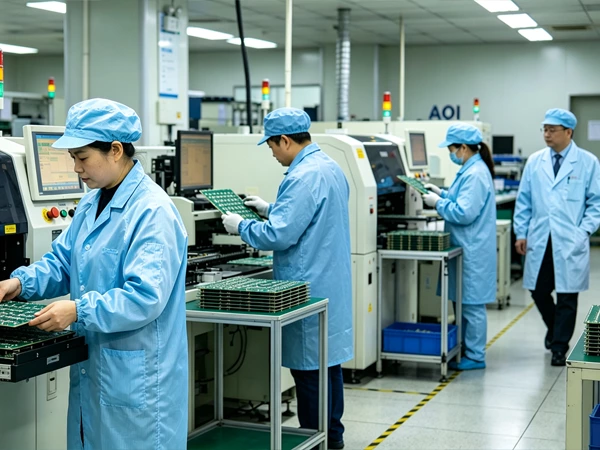
Our plant's mapping, in one line: light blue for line operators, dark or royal blue for engineers and line leads, red for quality control, white for visitors and temporary entrants, navy for maintenance and warehouse, green for supervisors and EHS.
Read on for the industry mapping, the comparison between the two, and a ten-minute checklist for auditing any plant's color code.
Why a PCBA factory assigns colors to people at all
A printed circuit board assembly line moves fast. Bare boards, moisture-sensitive reels, paste-printed panels and finished assemblies pass between a dozen pairs of hands inside an hour. Three problems appear at the same time:
- Electrostatic discharge (ESD). Every person walking into the assembly area is a static source. Anti-static garments are a functional requirement, not a fashion choice. ANSI/ESD S20.20-2021 — the American National Standard for establishing an ESD control program — sets the administrative and technical requirements a plant must meet, including personnel grounding and documented compliance verification.
- Role traceability. When a defect is found three days later, the plant must reconstruct who was authorized to touch that work order at each station.
- Access control. Visitors, contractors and customers should be instantly visible, so line staff can react if an unqualified person approaches an open machine or an ESD-protected area.
Color solves all three with almost zero training cost. That is why workwear color is one of the most useful things a buyer can read on a shop floor — and why it is worth understanding that each plant writes its own version of it.
The mapping most often quoted in the industry
This is the version you will meet in most documentation, most blog posts, and most trade explanations. Treat it as a starting hypothesis, not a rule:
| Role | Commonly quoted color | Common variation |
| Line operators / machine operators | White | Some plants reserve white for visitors or customer tour smocks, and give operators light blue |
| Engineers / technicians / line leads | Light blue or royal blue | Deep blue and sapphire blue both appear |
| Quality control: IPQC / OQC / QA | Pink or light rose | A minority of plants, mostly larger ones, use red |
| Visitors / customers / contractors / auditors | Yellow | Some plants give yellow to production or process engineers and issue white to visitors |
| Equipment maintenance / warehouse | Navy or dark blue | Chosen partly because it hides dirt |
| Workshop supervisor / manager / EHS | Green | Some plants use green for engineering management |
| QA / defect disposition specialist | Red | Rare — the plants that separate routine QC from escalation |
Three observations matter more than the table itself:
- Pink is the classic QC color in PCBA, which is why it is the one most often quoted. But "classic" is not "required."
- Every row has a documented alternative. The alternatives are not mistakes — they are other plants' standards.
- The two most volatile assignments are white and yellow, the two colors most likely to be given to visitors.
What our own plant actually uses
Here is where the industry mapping and our factory diverge — and this is the version you should hold us to.
| Role | Workwear color at Tecoo | What they do on the floor |
| Line operators / machine operators | Light blue | SMT station work, through-hole insertion, test station operation, board handling, production execution |
| Engineers / technicians / line leads | Dark blue / royal blue | Equipment maintenance, placement machine setup and fine-tuning, process improvement, line management |
| Quality control: IPQC / OQC / QA | Red | Patrol inspection, AOI inspection, finished goods inspection, process auditing and defect judgment |
| Visitors / customers / contractors / auditors | White | Anyone temporarily entering the workshop |
| Equipment maintenance / machine repair / warehouse | Navy / dark blue † | Equipment overhaul, spare parts, workshop logistics |
| Workshop supervisor / manager / EHS | Green † | Shop-floor management, safety and environment management |
| QA / defect disposition specialist | Red | Major quality anomaly handling |
† Marked rows follow the same colour as the common mapping. We mark them rather than hide them, so you can check them first: ask for the current version of the plant standard at the gowning station.
Why the difference exists. Our plant made a deliberate choice that inverts the most-quoted mapping: because visitors, customers and auditors are often first-time guests who have never been in an electronics workshop, we dress them in white and give the working population a color they cannot accidentally be mistaken for. It is easier to spot a guest who does not belong in light blue where everyone else is light blue, than to spot a guest in the same white an operator would wear.

For an operator, that inversion is trivial once it is explained. For a visitor, it is the difference between being correctly read as a guest and being mistaken for staff.
Working through each color as it appears at our plant
Light blue — line operators
Light blue is the working color. These are the people loading reels into placement machines, running the paste printer, doing through-hole insertion, operating AOI and functional test, and physically moving panels between stations. If your product is on a line, most of the hands it passes through wear light blue.
Dark blue and royal blue — engineers and line leads
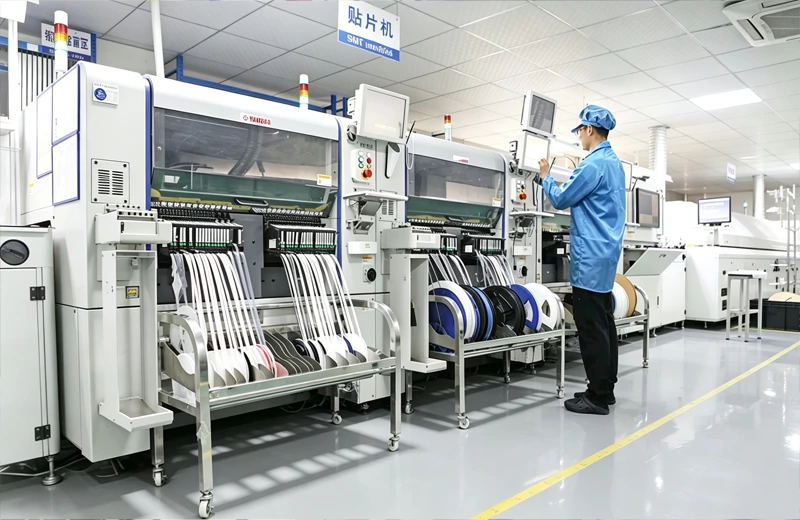
Blue in its darker shades is the problem-solving layer. When a placement machine throws a vision error mid-run, or first-pass yield dips on a fine-pitch panel, the blue-uniformed engineer is the person authorized to open the machine, change parameters and release the line again.
Operators run the standard process; engineers own the deviation from it. In a well-run plant you should be able to see both present on the floor during production hours.

Red — quality control
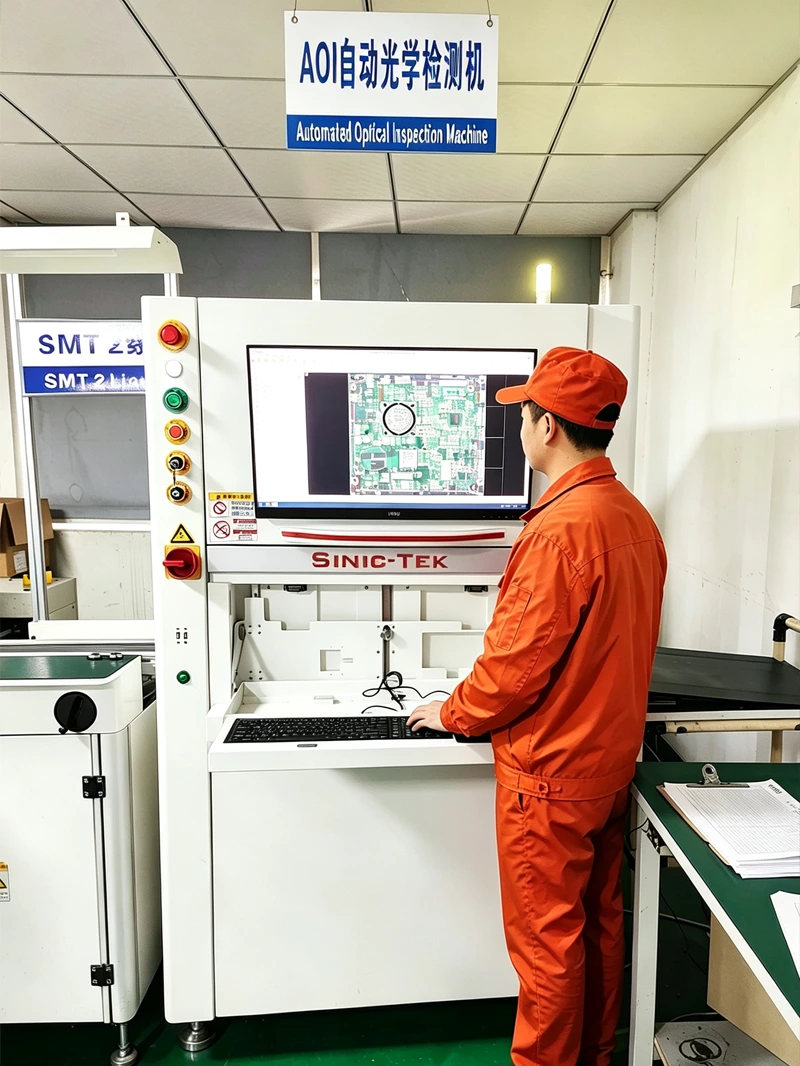
Red is our QC color, and it is the most informative color on the floor. IPQC staff walk the line checking paste deposition, component placement and solder joints. OQC staff make the final call before boards are packed. QA staff own the inspection procedure itself.
Because red is independent of the production chain, a buyer can use it as a quick sanity check: on a healthy line, red should be moving between stations regularly, not sitting in one corner. If you see no QC color on an active line, ask how outgoing inspection is actually staffed.
Note the difference from the industry mapping: in most plants you would look for pink. In ours you look for red.
White — visitors, customers and auditors
White is the guest color here, and the assignment is deliberate. It signals to every operator that the person approaching is not qualified to touch equipment, open cabinets or handle boards.
In plants that host frequent customer audits — normal for automotive, medical and industrial-control work — guest garments are usually kept at the entrance together with heel straps or shoe covers.
Navy — maintenance, machine repair and warehouse
Navy covers roles that support production rather than execute it: equipment overhaul, spare-part picking and workshop logistics. It is a practical color choice as much as a signaling one, because these roles work around lubricants, feeders and racks.
Green — supervision, management and EHS
Green marks authority on the floor: workshop supervisors and managers, plus environment, health and safety staff. When a decision needs escalating — a line stop, a rework call, a safety issue — green is who it goes to.
Caps, shoes and masks
Headwear is a second identifier layer:
| Item | Color | Meaning |
| Operator cap | White | General production staff |
| QC cap | Red | Quality control |
| Visitor cap | Yellow | Visitors and guests |
The QC cap is red in our plant. The operator and visitor caps follow the common mapping — check both against the current plant standard on site.
Two details matter more than the color:
- Cover the hair, fully. Hair is one of the largest static generators in an electronics workshop. A cap that leaves hair exposed is decorative, not protective — the requirement is that hair is completely contained.
- Shoe and mask choice is task-specific, and the two mask types are not interchangeable. ESD footwear relies on a conductive sole that grounds the wearer; that sole layer wears down with use, so shoes are inspected and replaced on a schedule rather than worn until they fail. Our plant stocks ESD footwear in both black and sapphire blue; the color does not change the specification, but the sole condition does. On masks: a cleanroom mask belongs to SMT printing and AOI work, where contamination control matters, while a fume mask belongs to wave soldering, where flux fumes matter. Using one type for the other job means the wearer is either unprotected or contaminating the product.
Where any color system breaks down: the four real confusions
Because color language is a plant-level convention with no global standard, four overlaps cause most of the mistakes visitors make:
- White: operator or guest? The industry mapping says operator; our plant and a number of others reserve white for visitors.
- Pink versus red for quality. The classic PCBA convention is pink. A minority of plants, including ours, put QC in red — which in other plants signals escalation.
- Yellow: visitor or engineer? Yellow is normally the guest color, but some plants assign it to production or process engineers.
- Green: shop floor management or engineering management? Both mappings exist.
There is also an important limit to what color proves. The color tells you a role, not a qualification. A red smock does not certify that the wearer holds an IPC-A-610 inspector credential, and a dark blue smock does not certify a specific machine qualification. For anything that matters contractually, ask for the training and certification records — and check whether the plant builds to IPC-A-610J, the current edition of the most widely used acceptance standard for electronic assemblies.
A 10-minute buyer checklist for workwear color
- Ask for the plant's own visual standard document before you enter the workshop, and read the color map yourself. Never carry one plant's map into another plant.
- Verify one role end-to-end. Pick the QC color. Ask an operator to point out the QC person, then ask that person what they inspected in the last hour. The color and the answer should match.
- Check the visitor protocol. Are you wearing the visitor color? Is it visually distinct from the working population?
- Look at the shoe and heel-strap setup at the entrance you used. ESD grounding only works if the wearer is actually grounded.
- Check mask types at the printing station and at the wave solder station. They should not be the same mask.
- Ask what happens on a color conflict — a contractor who is also an engineer, for example. The answer reveals whether the color system is managed or merely purchased.
- Ask whether the color scheme is written down and version-controlled, or passed on verbally. A documented standard can be audited; a verbal one cannot.
FAQ
1. What does a pink uniform mean in a PCB factory?
In the most commonly quoted industry mapping, pink marks quality control — IPQC, OQC and QA. However, it is a convention rather than a rule, and a minority of plants, including ours, use red for QC instead. Always confirm against the plant's own written standard.
2. What does a white uniform mean in a PCBA factory?
It depends entirely on the plant, which is why white is the color most likely to mislead a visitor. In the most commonly quoted mapping, white marks line operators. In our plant, white is reserved for visitors, customers, contractors and auditors, and the operators wear light blue.
3. What does a red uniform mean in a PCB assembly plant?
In the common mapping, red is used by QA staff handling major defect disposition and is otherwise rare. In our plant, red is the quality control color and covers IPQC patrol inspection, OQC finished-goods inspection and QA.
4. Who wears yellow in a PCB assembly plant?
Normally visitors, customers, contractors and external auditors — the guest color, chosen to be obvious at a distance. A minority of plants use yellow for production or process engineers instead. At our plant the visitor garment is white — deliberately the opposite of the common mapping — so a guest cannot be mistaken for staff.
5. Do all PCBA factories use the same workwear colors?
No. There is no mandatory international standard for workwear color, and plants differ substantially — most visibly on white and yellow, and on whether QC wears pink or red. The mapping in this article is the common version; our own factory's version is documented above and differs from it.
6. Are these garment colors required by an international standard?
No. ANSI/ESD S20.20-2021 sets the requirements for an ESD control program, including personnel grounding and documented compliance verification, but it does not prescribe which color belongs to which role. The color language is a plant-level convention.
7. Is an anti-static garment the same thing as an ESD-safe garment?
Not automatically. Two garments can look identical and have different electrical properties. ESD-rated and ordinary versions exist in the same color, which is why garment selection should be backed by specification review and testing rather than by appearance.
8. How does the visitor color help during a customer audit?
It protects both sides. You are visually flagged as non-production personnel, so operators can challenge you if you reach for a board or open a machine — which is exactly the behavior you want to see in a plant that will handle your product.
The takeaway
Workwear color is the cheapest quality system a PCBA factory owns. It costs nothing to maintain and it lets anyone on the floor answer "who is allowed to do this?" in under ten seconds. But it is a convention, not a regulation: no external standard mandates the mapping, and the common version and the real version often differ.
So use it the right way. Learn each plant's own color standard before you walk in — including ours, which is published above rather than assumed — verify one role end-to-end, and treat color as a pointer to the paperwork rather than a substitute for it.
Our shop-floor visual standard is documented and available to visiting customers, and we will walk a buyer through it station by station as part of a factory audit. If you are evaluating PCB assembly partners for industrial control, security, automotive, medical, appliance or consumer programs, you can read more at maxcontro.com.
Continue the series: red, yellow, green, blue and black tote boxes tell you the status of your boards at a glance — see PCBA Tote Box Colors Explained.
Sources and further reading
- ANSI/ESD S20.20-2021, Protection of Electrical and Electronic Parts, Assemblies and Equipment — program requirements, personnel grounding and compliance verification. ANSI overview
- ANSI/ESD S1.1-2021, Standard for Wrist Straps — product qualification and testing of the wrist strap system used with personnel grounding. ANSI overview
- IPC-A-610J-2024, Acceptability of Electronic Assemblies — the most widely used acceptance criteria standard for electronic assemblies. ANSI overview · IPC store