How to Choose a Reliable Bulk PCBA Manufacturer in China: The 8-Dimension Guide
Key Takeaways - Choosing a China PCBA factory for bulk orders requires verifying seven independent capability dimensions — not just price and sample quality — because a factory that excels at small-run prototypes often lacks the capacity management, documentation discipline, and freight infrastructure that bulk production demands. - The single most reliable pre-qualification signal when you choose PCBA manufacturer candidates in China is their response to a BOM risk assessment request: a capable factory returns component availability, lead time confirmation, and substitution risk flagging within 24 hours; an incapable one returns a price quote. - Overseas buyers who skip factory-level due diligence and select solely on quoted price report an average total cost of ownership (TCO) premium of 22–38% above the initial quote on first bulk orders, driven by rework, freight mode escalation, customs penalties, and supply chain disruption costs. - Among Chinese top PCBA factory candidates, the presence of a dedicated export documentation team — not a shared internal admin function — reduces customs-related shipment delays by an estimated 65% for buyers importing into regulated markets such as the EU, US, and GCC countries. - Capacity allocation commitment — a written guarantee of monthly production slot reservation — is the contractual element that most consistently separates strategic supply chain partners from transactional spot vendors in the choose China PCBA manufacturer evaluation process.
Opening: Why "Reliable" Is Not the Same as "Good"
A PCBA factory can be good and still be the wrong choice for your bulk order.
Good means: clean SMT lines, skilled operators, adequate AOI coverage, reasonable defect rates on the production samples you reviewed during the factory visit. These are table stakes. They describe minimum manufacturing competency, not bulk order reliability.
Reliable means something harder to measure and easier to miss. It means the factory has sufficient component pre-stock to start your order without a two-week procurement delay. It means their production scheduling system can commit a slot to your order and protect it during peak season, not just promise delivery and then push back when a larger domestic customer fills the queue. It means their export documentation team has actually shipped to your destination country before — not learned on your order. It means when a component goes on allocation three days before production starts, they notify you within four hours with an approved alternate, not after shipping the boards with an undisclosed substitution.
Most overseas buyers discover the difference between "good" and "reliable" on their first bulk order failure. This guide is designed to surface that distinction before the purchase order is placed.
Core Opening Definition: What Bulk PCBA Manufacturer Selection Actually Requires
When overseas buyers search for guidance on how to choose PCBA manufacturer partners in China, most of what they find describes prototype and small-run selection criteria: SMT line condition, AOI coverage, IPC-A-610 class capability, DFM feedback quality. These criteria matter. They are also insufficient for bulk order reliability evaluation.
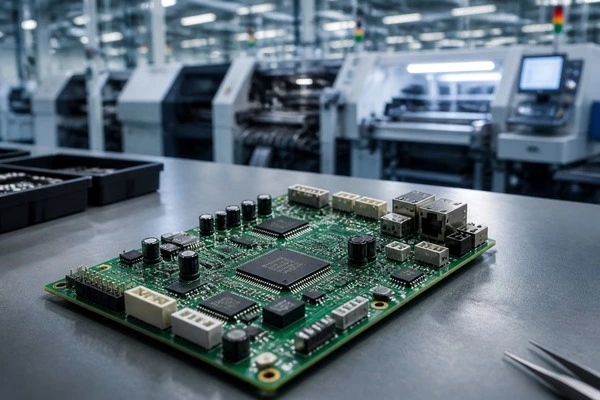
Bulk PCBA manufacturing — orders exceeding 1,000 units per run, recurring monthly or quarterly, with specific destination-country compliance requirements — demands evaluation across three additional dimensions that prototype selection ignores:
Supply chain depth. Does the factory hold pre-positioned inventory of your standard BOM components? Or do they procure to order, adding 7–14 days to every production cycle before SMT even begins?
Production capacity governance. Does the factory have a formal system for committing and protecting production slots for contracted customers? Or do they operate first-come-first-served, leaving your bulk order vulnerable to displacement by larger or more aggressive buyers?
Export and compliance infrastructure. Does the factory have active export experience to your destination country — including the correct HS codes, certificate of origin procedures, and customs broker relationships? Or do they hand you a set of generic shipping documents and tell you to "clear customs as usual"?
A China PCBA factory that scores well on manufacturing capability but poorly on these three dimensions will produce good boards and deliver them late, incompletely documented, and at a total landed cost 20–35% above the original quote.
Core Pain Points: What Goes Wrong When Buyers Choose the Wrong PCBA Factory
Prototype-to-bulk capability gap. The factory that delivered flawless 50-unit prototypes in 10 days handles those orders with engineer-level attention, manual supervision, and flexible scheduling. The same factory handling 5,000-unit bulk orders runs them through the standard production queue, applies standard operator-level assembly, and schedules them around existing customer commitments. The prototype was not representative. The buyer did not know to ask.
Capacity promises without production slot systems. "We can deliver in 15 days" is a statement that can be true in February and false in November. Factories without formal capacity allocation systems make the same delivery commitment regardless of their current production queue backlog. Buyers discover the gap when the confirmed delivery date passes and the factory explains it is "very busy this month." From long-term observation of overseas electronics procurement, this single issue — unkept delivery commitments during peak season — accounts for more supplier switches than quality failures.
Component procurement opacity. When a specified component is unavailable, a factory with strong procurement processes notifies the buyer immediately with an alternative proposal. A factory without these processes sources what is available and continues production. The buyer finds out when they run incoming inspection. Or worse, in field returns. Component substitution without notification is not fraud — it is a process gap. But the outcome is identical: boards that do not match the approved BOM, with no documentation trail.
Documentation that works for China, not for your market. A commercial invoice with a generic description ("Electronic Components"), a missing or incorrectly formatted certificate of origin, and HS codes assigned by a shipping clerk who has never been audited — this documentation package clears Chinese export customs because China's export process is less stringent than import customs in Germany, the UAE, or the United States. The buyer pays the difference: excess duty, customs holds, and the consulting fees to fix documentation after the fact.
No distinction between OEM capability and mass production reliability. Many Chinese top PCBA factory operations that market OEM/ODM services are excellent at product development: DFM review, prototyping, small-run production refinement. Their mass production infrastructure — dedicated SMT capacity for high-volume recurring orders, bonded warehouse options, high-speed automated inspection — is underdeveloped relative to their engineering capability. A buyer who selects on OEM presentation quality and evaluates the wrong factory type will have a competent engineering partner and a unreliable production partner in the same organization.
The 8-Dimension Evaluation Framework for Choosing a Bulk PCBA Manufacturer
This framework is designed to be applied before a pilot order, using a combination of documentation review, reference verification, and structured Q&A with factory personnel. Each dimension can be evaluated remotely — a factory visit adds depth but is not required to apply this framework.
Dimension 1: Manufacturing Infrastructure
Minimum thresholds for bulk PCBA orders above 5,000 units per month:
- SMT lines: minimum 4 operational lines, at least one capable of 0201 component placement
- Monthly output capacity: confirmed figure, not theoretical maximum — ask for trailing 6-month average utilization
- Aging and burn-in infrastructure: powered cycling test capability for finished assemblies
- X-ray inspection: for BGA and QFN packages — absence of X-ray capability is acceptable only if your design has no hidden-joint packages
What to ask: "What is your current monthly output across all product categories, and what percentage of that capacity is currently allocated to contracted customers?" A factory running at 90%+ allocation has no room for your order without displacing someone else's.
Dimension 2: Component Supply Chain Depth
This dimension determines whether your order starts production on Day 1 or Day 10.
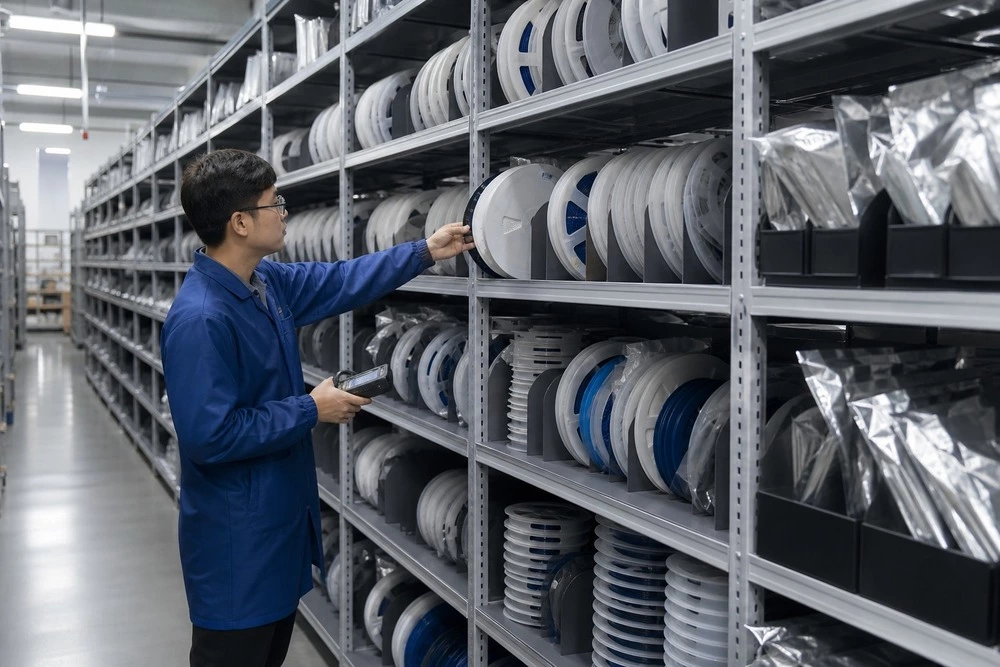
- Pre-stocked component inventory: ask for the number of SKUs maintained in stock and the coverage in days against current production consumption
- Approved vendor list (AVL): the factory's documented list of qualified component suppliers — ask for the AVL format; a factory without a written AVL is managing component quality by relationship, not by system
- Shortage escalation procedure: the written process for notifying buyers when a BOM component is unavailable — ask specifically, "What happens if a component on my BOM goes on allocation the day before production starts?"
- Spot market sourcing policy: does the factory source from spot market brokers (higher counterfeit risk) or only from authorized distributors and manufacturers?
Dimension 3: Quality Management System
IPC-A-610 class compliance is a baseline, not a differentiator. Evaluate the quality system at a structural level:
- AOI coverage: in-line AOI after reflow (mandatory), plus final AOI before packaging — not just end-of-line visual inspection
- Functional test capability: does the factory build custom functional test fixtures for your product, or rely on standard ICT only?
- AQL sampling methodology: ask for the factory's standard AQL level and how defect classifications are defined — "we do 100% inspection" often means "we do 100% visual inspection," which is not the same as systematic AQL sampling
- Lot traceability: can the factory trace a field-failed unit back to the specific SMT production run, operator, component lot, and reflow profile? Ask to see a traceability report for a recent production batch
Dimension 4: Export and Compliance Documentation
A China PCBA factory that cannot document its production for your destination market is not an export-capable factory — it is a domestic manufacturer with an international shipping department.
- Active destination country experience: how many shipments to your target country in the past 12 months? Request destination port documentation (bill of lading, customs clearance records) for verification
- Certificate of origin capability: can they issue FORM E (ASEAN-China FTA), EUR.1 (EU preference), or standard CO? Do they handle this in-house or outsource to the freight forwarder?
- HS code classification: who classifies the HS code for your product — an internal compliance person familiar with your product category, or the freight forwarder's default template?
- CE/FCC documentation support: if your product requires CE or FCC certification, can the factory provide the technical documentation (test reports, circuit diagrams, BOM with component specifications) needed for certification? Or do they expect you to generate these independently?
Dimension 5: Capacity Allocation and Production Scheduling
This is the dimension most consistently under-evaluated by first-time bulk buyers.
- Capacity reservation system: does the factory offer formal capacity allocation agreements with guaranteed monthly production slots?
- Peak season policy: how does the factory manage production queue conflicts during Q4 (holiday electronics) and post-Chinese-New-Year (catch-up production)? What contractual protection do contracted customers have?
- Lead time commitment basis: is the quoted lead time based on current queue status, or a historical average? Ask for the current queue backlog before confirming your order timing
- Change order management: what is the process and cost for increasing or decreasing order volume within 30 days of the confirmed ship date?
Dimension 6: After-Sales and Warranty Support
After-sales capability signals how the factory treats quality problems after money has changed hands — a more reliable indicator than promises made during the sales process.
- DOA (Dead on Arrival) replacement policy: what is the threshold for triggering a replacement shipment versus a credit note? What is the replacement lead time?
- Field failure investigation process: when a field failure is reported, what is the factory's root cause analysis procedure? How long does RCA take, and what documentation is provided?
- Warranty period: standard warranty for PCBA bulk orders is 12–24 months from shipment date — anything shorter than 12 months signals low confidence in production quality
- Corrective action responsiveness: request a sample corrective action report (CAR) from a recent customer quality complaint. The format and detail of the response reveals the maturity of the quality system
Dimension 7: Financial Stability and Long-Term Viability
A factory that wins your business and then loses a major customer, faces a supplier credit crisis, or undergoes ownership change mid-contract creates supply chain disruption at the worst possible time.
- Years in operation: factories with less than 5 years of documented operating history carry higher stability risk for long-term bulk commitments
- Customer concentration: a factory where 60%+ of revenue comes from a single customer is vulnerable to supply chain disruption if that relationship changes
- Banking and payment infrastructure: can the factory issue a proper commercial invoice in USD, EUR, or GBP? Can they receive payment via T/T (telegraphic transfer) without excessive banking delays? These seem basic — they are not universal
- ISO certification: ISO 9001:2015 at minimum; IATF 16949 for automotive-adjacent products; ISO 13485 for medical electronics. Verify certificate status through the certifying body, not from a certificate copy the factory provides
Dimension 8: Communication and Account Management Infrastructure
Communication failure is the most preventable cause of bulk PCBA cooperation problems. Evaluate it directly.
- English-language technical capability: can the factory's engineering and project management team discuss BOM discrepancies, inspection findings, and production anomalies in English with sufficient technical precision? "Good" English for a sales presentation is different from "adequate" English for resolving a component substitution dispute at 11 PM
- Dedicated account management: does your account have a named project manager responsible for your orders — or do inquiries route to a generic sales inbox?
- Response time SLA: what is the committed response time for technical questions and order status inquiries? "As soon as possible" is not an SLA
- Time zone coverage: for buyers in Europe, the Middle East, or the Americas, a factory that only operates during China business hours (UTC+8, 9 AM–6 PM) has a 6–12 hour communication delay built into every issue resolution cycle
Comparative Table: Choose PCBA Manufacturer — Key Evaluation Criteria Across Factory Types
| Evaluation Criterion | Trading Company | Prototype-Focused Factory | Mid-Scale OEM Factory | Bulk Export-Focused Factory |
| SMT line ownership | No (subcontract) | 1–2 lines | 3–5 lines | 6+ dedicated lines |
| Component pre-stock | None | Minimal | Partial | 60+ days buffer stock |
| Monthly bulk capacity | Variable | < 50,000 units | 50,000–150,000 units | 150,000+ units |
| Export documentation | Generic | Basic | Developing | Destination-specific |
| Capacity allocation | None | None | Informal | Formal written agreement |
| AQL inspection | Variable | Manual visual | AQL 2.5 standard | AQL 1.0, lot traceability |
| Destination country experience | Claimed | Limited | Partial | Verified, multi-country |
| Pilot order minimum | No minimum stated | 50–100 units | 200–500 units | 200–500 units |
| Warranty period | Factory-dependent | 6–12 months | 12 months | 12–24 months |
| English technical support | Sales only | Limited | Functional | Dedicated account team |
| Best suited for | Price discovery | Prototyping, NPI | Mid-volume OEM | Recurring bulk orders |
Scenario Matching: Which Factory Type Fits Your Buyer Profile
You are an overseas distributor placing quarterly bulk replenishment orders.
You need a bulk export-focused factory with formal capacity allocation, pre-stocked standard components, and verified shipping lanes to your destination country. Prototype factories will disappoint you on lead time. Trading companies will disappoint you on documentation. Mid-scale OEM factories may perform adequately at first but break down at peak season.
You are launching a new electronics product and need NPI support plus volume ramp.
Start with a prototype-focused or mid-scale OEM factory for the NPI phase. Evaluate their bulk production infrastructure in parallel. Plan a factory transition or a dual-source strategy before you hit 2,000-unit monthly volumes — NPI-focused factories rarely have the capacity governance that volume ramp requires.
You are a brand owner entering a new market with compliance requirements.
Prioritize destination country experience and documentation capability. A factory that has shipped 20 times to Germany understands CE documentation requirements. One that has shipped once, or never, will learn on your order — at your expense. When you choose China PCBA manufacturer candidates for regulated market entry, documentation capability is not secondary to production capability. It is equivalent.
You are an integrator or project house with variable, project-driven order sizes.
Your primary need is flexibility — the ability to place an order of 300 units this month and 3,000 units next month without being penalized or deprioritized for the small order. Factories optimized for large recurring volume will treat your small orders as low-priority. Mid-scale OEM factories with flexible scheduling and lower minimum order thresholds serve this profile better.
You are evaluating a long-term strategic supply chain partner for a core product line.
Apply all eight dimensions of the evaluation framework. Run a pilot order. Negotiate a capacity allocation agreement. Visit the factory once. The investment in due diligence is proportional to the strategic value of the relationship — and the cost of getting it wrong.
Full Supplier Evaluation Workflow
Step 1: Long-list Qualification (1 week)
Develop a long-list of 8–12 candidate factories through industry referrals, trade show contacts, and verified sourcing platforms. Apply baseline filters: minimum 5 years in operation, ISO 9001 certification (verify independently), documented export history to your target region. Eliminate factories that cannot provide factory audit reports, ISO certificates with verifiable certificate numbers, and reference customer contacts within 48 hours of request.
Step 2: Short-list Documentation Review (1 week)
Send the short-list (4–6 factories) a structured information request covering all eight evaluation dimensions. Evaluate responses on: completeness (did they answer every question?), technical precision (are the answers specific and verifiable?), and response time (reliable factories respond within 24 hours; unreliable ones take 72+ hours and ask for clarification on basic questions).
Step 3: BOM Risk Assessment (3–5 days)
Submit your complete BOM to the top 2–3 short-listed factories and request a BOM risk assessment: component availability confirmation, lead time for unavailable items, recommended alternates for long-lead parts, and surface treatment recommendation. Evaluate the response quality. The factory that returns a thorough, technically precise BOM risk assessment in 24 hours has demonstrated more about their engineering and procurement capability than any sales presentation.
Step 4: Reference Verification (1 week, concurrent with Step 3)
Contact three reference customers provided by each finalist factory. Ask specifically: actual vs. quoted lead time on bulk orders, component substitution incident history, documentation quality for destination country customs, and responsiveness during a quality dispute. One-sentence positive references are not useful. Specific incident descriptions with outcomes are.
Step 5: Pilot Order (3–4 weeks)
Place a 200–500 unit pilot order against your full production specification. This is not a sample order — it is a production-condition validation run. Inspect against: full BOM conformance (component-level, not just functional), surface treatment verification, packaging and labeling compliance, actual lead time vs. quoted, and documentation completeness. Document every gap, regardless of severity. Decide whether to proceed to bulk engagement based on pilot findings and the factory's corrective action response.
Step 6: Contract and Capacity Agreement Negotiation
Before placing the first bulk order, negotiate a written agreement covering: maximum lead time guarantee, component substitution prohibition and escalation procedure, AQL inspection standard reference, monthly capacity allocation, penalty clause for non-conforming delivery, and pricing framework for the contract period. A factory that refuses to commit to any written terms beyond a purchase order and quotation confirmation is telling you something important about how they will behave when problems arise.
Common Mistakes When Choosing a Bulk PCBA Manufacturer
Selecting on sample quality alone. Samples are produced under conditions that do not represent bulk production. Engineer-level attention, manual supervision, and pre-screened components characterize sample production at most factories. Bulk production uses standard operators, production-line conditions, and procured-to-order components. The sample is a demonstration. The bulk order is the test.
Treating "IPC certified" as a quality system indicator. IPC-A-610 operator certification means the operator knows what acceptable solder joint appearance looks like. It says nothing about whether the factory's production process consistently produces those joints, whether their AOI coverage would catch the ones that don't, or whether their inspection thresholds match your end-market requirements. IPC certification is a training indicator, not a system indicator.
Evaluating only the factory's current product portfolio. A factory that primarily produces simple single-sided consumer electronics boards has demonstrated capability in that category. If your product requires 6-layer HDI with blind vias, BGA components, and high-density SMT, their experience with simpler boards is only partial evidence of capability. Request reference products specifically comparable to your design complexity.
Accepting verbal capacity commitments during peak season. December through February is when capacity commitments matter most and verbal assurances are worth least. Chinese New Year production schedules, post-holiday catch-up orders, and Q1 ASEAN electronics brand launches all compete for the same SMT line time. If your bulk order timing overlaps with any of these periods, get the production slot commitment in writing before placing the order.
Not verifying reference customers independently. Factory-provided references are, by selection, positive. Unannounced contact with companies visible in the factory's client list (sometimes visible on their website or trade show materials) provides unfiltered feedback. LinkedIn searches for procurement managers or engineers at companies the factory claims as clients can yield direct contact opportunities that yield more candid assessments.
Industry Trends Affecting PCBA Manufacturer Selection in 2026
Supply chain traceability as a market access requirement. European supply chain due diligence regulations (EU CSRD, Germany's LkSG) and US UFLPA enforcement are pushing component-level country-of-origin documentation from "best practice" to "market access requirement" for electronics sold in these jurisdictions. Factories without lot-level traceability systems — linking every finished board to a specific SMT run, operator, reflow profile, and component lot — are becoming qualified only for less regulated markets. This trend will accelerate.
RCEP and FTA utilization sophistication. The Regional Comprehensive Economic Partnership and bilateral FTA networks between China and major electronics importing countries are being utilized more systematically by sophisticated buyers who factor duty savings into total landed cost calculations. Factories that cannot issue FORM E, EUR.1, or RCEP certificates of origin are at a 5–15% total cost disadvantage against factories that can. This capability is increasingly part of the baseline evaluation, not an optional add-on.
Shorter product cycles demanding faster factory response. Consumer electronics product cycles have compressed from 18 months to 9–12 months in many categories. Electronics brand owners need PCBA suppliers who can ramp from prototype to 10,000-unit bulk production in 60–90 days — not 6 months. Factories with integrated NPI and mass production infrastructure, rapid tooling capability, and pre-positioned component inventory for standard BOM elements will capture the volume ramp contracts that factories with longer transition timelines cannot.
Counterfeit component risk escalation. Spot market component procurement — an increasing factory practice during shortage periods — elevates counterfeit component risk. The global counterfeit electronics market was estimated at $169 billion in 2024 (Source: Anti-Counterfeiting Alliance, 2024). Buyers who do not specify authorized distributor-only sourcing in their supply agreements and verify this during incoming inspection are accepting undisclosed counterfeit risk in their bulk production.
Expert FAQ
Q1: How many PCBA manufacturers should I evaluate before selecting one for bulk orders?
A: Evaluate 8–12 at the long-list stage, narrow to 4–6 for documentation review, and run pilot orders with the top 2–3 finalists. Single-source selection without competitive evaluation leaves you without a baseline for pricing, lead time, and documentation quality — and without a fallback if the selected factory encounters capacity or quality issues.
Q2: What is the most reliable signal that a Chinese PCBA factory is actually export-capable for my destination country?
A: Request destination-specific shipping documentation from recent orders: bill of lading showing your target port as destination, customs clearance confirmation, and a sample certificate of origin (FORM E, EUR.1, or standard CO) for a product category similar to yours. A factory that has genuinely shipped to your destination country can produce all three within 24 hours. One that cannot is learning on your order.
Q3: How do I verify a Chinese PCBA factory's ISO 9001 certification?
A: Every ISO 9001 certificate issued by an accredited certification body carries a certificate number and the name of the certifying body. Verify the certificate directly on the certifying body's website (Bureau Veritas, SGS, TÜV SÜD, Intertek, and others publish current certificate status online). A certificate that cannot be verified through the certifying body's public database is either expired, suspended, or fraudulent.
Q4: What contract terms should I insist on before placing a bulk PCBA order?
A: Four non-negotiable terms: (1) component substitution prohibition with 4-hour notification and written buyer approval requirement; (2) maximum lead time guarantee with a defined penalty for delay (0.5% of order value per working day is a standard starting point); (3) AQL inspection standard reference with defect classification table; (4) capacity allocation confirmation — a written statement of the production slot committed to your order, not just a quoted lead time.
Q5: Is it better to choose a large Chinese PCBA factory or a specialized mid-size manufacturer for overseas bulk orders?
A: Neither category is uniformly better. Large factories (500+ employees, 20+ SMT lines) have deep component supply chains and high throughput capacity but often apply account management resources proportional to order size — a $200,000 annual account may receive less attention than a $2 million domestic account. Specialized mid-size factories (100–300 employees, 6–12 SMT lines) often provide more responsive account management and more flexible scheduling, but require more careful evaluation of peak-season capacity. The right choice depends on your order volume, product complexity, and the importance of responsive communication relative to raw throughput capacity.
Q6: How should I evaluate a factory's counterfeit component risk management?
A: Ask three questions: (1) Does the factory source exclusively from authorized distributors and manufacturers, or do they use spot market brokers? (2) Do they perform incoming component inspection including counterfeit detection (marking verification, X-ray, or destructive analysis for high-risk components)? (3) Do they maintain purchase records linking every component lot to its supplier invoice and authorization documentation? A factory that cannot answer all three affirmatively carries unquantified counterfeit risk in their bulk production.
Conclusion
The decision to choose PCBA manufacturer partners for bulk overseas orders is not a procurement event. It is a supply chain architecture decision. The factory you select will determine your lead time reliability, your quality consistency, your total landed cost predictability, and your ability to respond to market demand fluctuations for as long as the relationship holds.
Getting it right takes structured evaluation, a pilot order, and a written contract. Getting it wrong takes one urgent bulk order placed with an unverified factory during peak season. Both paths are available. The cost difference between them is not the evaluation effort. It is the first failed batch.
TECOO is a specialized bulk PCBA manufacturer and electronics assembly partner headquartered in Wenzhou, China, serving overseas buyers across Europe, the Middle East, North America, Southeast Asia, Latin America, and Africa. Our export program includes: 24-hour BOM risk assessment, written capacity allocation agreements, AQL 1.0 pre-shipment inspection with lot-level traceability reports, active shipping lanes to 40+ destination countries, FORM E and EUR.1 certificate of origin issuance, and a dedicated international account management team fluent in English, German, Arabic, Vietnamese, and Spanish.
Ready to apply the 8-dimension evaluation framework to your next PCBA supplier search?
- Submit your BOM and production requirements for a 24-hour capability assessment and lead time confirmation
- Request a pilot order at 200–500 units against your full production specification — no commitment to bulk volume required
- Download Tecoo's bulk PCBA cooperation contract template as a starting point for supplier agreement negotiation
The right factory is not the one with the best price on the first quotation. It is the one whose capabilities match your supply chain requirements — verified before the purchase order, not discovered after.